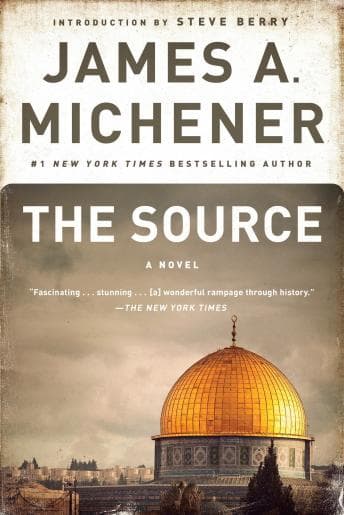

Okay, I need to vent about something first. You know what's genuinely unfair? When a book is THIS ambitious - 54 hours, thousands of years of Jewish history, the kind of scope that makes you feel small just reading the back cover - and then the narrator sounds like he's reading quarterly earnings reports to an empty boardroom. That's the central injustice of this audiobook, and I'm going to be honest about it.
I started The Source during a rare stretch of quiet nights at the unit. Not driving home - actually sitting in the break room at 4 AM, feet up, eating leftover adobo my mom had sent with Carlos. Something about that hour, that particular kind of tired where your brain goes soft and open, made me want something enormous. Michener felt right. 54 hours of civilization felt right.
And the book itself? Genuinely extraordinary. Michener structures The Source around an archaeological dig in modern Israel, and then spirals backward through time - each artifact uncovered at the fictional site of Makor becomes a doorway into a full story: early Hebrew tribes, Roman occupation, the Crusades, the Spanish Inquisition, the founding of Israel. These aren't footnotes or summaries. They're full, breathing narratives with characters you get attached to before Michener rips them away from you across centuries. He did his homework in a way that reminds me of the doctors I respect most - the ones who actually read the literature before they open their mouths. That same quality of earned, lived-in historical weight is something I found in Those Who Leave and Those Who Stay — Ferrante does something similar with class and labor history, grounding big ideas in people you can't stop thinking about. The historical detail is dense but never feels like a lecture. It feels like someone who cared deeply about getting it right.
When A Book Is Doing Too Much Work For Its Own Audio
Here's my problem. Michener's prose has a particular weight to it - measured, deliberate, building. It rewards the right kind of attention. Larry McKeever's narration does not give it that weight. Other listeners have called him robotic and monotonous, and I want to be fair because clarity matters - he IS clear, pronunciation of difficult historical and Hebrew terms is generally solid, which is genuinely not easy. But the emotional range? Flat. Consistently, exhaustingly flat. There's a passage where a Jewish family faces the Inquisition and what should be devastating lands like a weather report. I kept waiting for something - a catch in the voice, a shift in pace, anything - and it never came.
Someone in a review I read said he sounds like he's reading a newspaper article, and that's accurate. The problem is that Michener is not writing newspaper articles. He's writing about people surviving impossible things across three thousand years of history. That gap between what the text is doing and what the narration is doing is exhausting over 54 hours. I ended up bumping to 1.25x just to add some energy the performance wasn't giving me.
I didn't yell at my dashboard on this one. I just got quiet in a way that felt like disappointment.
54 Hours Is A Commitment, Not A Casual Suggestion
If you're going to do this - and I think you should, eventually, because the book deserves it - go in with a plan. This is not background listening. This is not fall-asleep listening. Michener's structure means you're constantly meeting new characters, new time periods, new contexts, and McKeever's flat delivery means the text has to do all the work of signaling those transitions. You need to be paying attention or you'll surface somewhere in the Crusades confused about who everyone is.
My mom would love this book, by the way. She grew up Catholic in Manila and has this deep, almost physical need to understand religious history. She'd probably make me explain every section to her over the phone. She would also definitely tell me I should've been a historian instead of a nurse. Some things never change.
Read the book. If you can get the print version, maybe do that instead. Or find a different narrator. The Source deserves better than what it got here - but it's too important a work to skip entirely just because the audio version is fighting against itself.