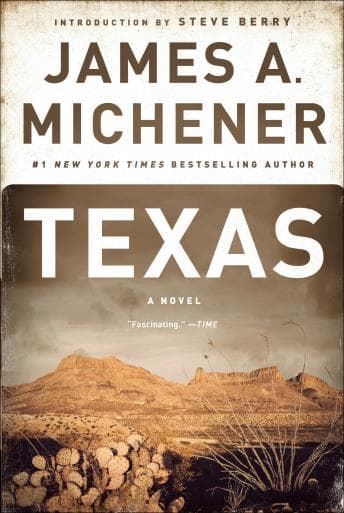

"An honorable craftsman doing honorable work." That's what the Boston Globe said about Michener, and honestly? After 65 hours with this beast, I think that's the most precise description of his writing I've ever heard. Not flashy. Not experimental. Just a guy who did his homework and then built you an entire state out of words.
So here's the thing - I started this during a weekend where I was supposed to be working on my thesis proposal. Dr. Patel had sent me one of those emails with the subject line "Checking In" that really means "I'm checking up on you." I told myself I'd just listen to the first chapter while organizing my board game shelf. That was Saturday morning. By Sunday night I hadn't touched my proposal, my board games were still a mess, and I was somewhere in the 1830s watching Texas fight for independence.
Michener Built a Whole State the Way Sanderson Builds Magic Systems
Look, I know comparing Michener to Sanderson is going to get me weird looks, but hear me out. What Michener does with Texas is essentially world-building on a geological timescale. He starts with the literal land - the rivers, the soil, the climate - and then layers civilizations on top like he's generating a procedural map. (And yes, I see the irony given my thesis topic. No, I will not be citing Michener in my literature review. Probably.)
The structure follows four families across four centuries: Spanish conquistadors, Anglo settlers, a ranching dynasty, and eventually oil money families. Each generation gets its own mini-epic, and the transitions between eras feel like loading into a new campaign setting where the geography is the same but the rules have changed. If you don't like info-dumps, this isn't for you (but you're wrong). Michener will spend thirty minutes explaining how a particular river bend shaped settlement patterns, and I'm sitting there like a DM taking notes for my next homebrew.
The scope is genuinely Sanderson-level world-building, except instead of investiture and spren, you're getting cattle drives and oil derricks. The historical detail is staggering - the Texas Rangers sections alone feel like an entire campaign sourcebook. And the way he weaves the Mexican-Texan cultural conflict through centuries, showing how the same tensions resurface in different forms? That's the kind of long-form storytelling that makes a 65-hour commitment feel justified. Yes, it's 40 hours. Actually it's 65. Yes, it's worth it.
Larry McKeever Is Where This Whole Thing Falls Apart
Okay. So. The narration.
I need to be honest here because the story earned better than what it got. Larry McKeever's delivery is - and I'm being as generous as I can - monotone. Not in a understated, literary way. In a "this might actually be a text-to-speech program from 2008" way. Multiple listeners have compared it to a computer voice, and while that's harsh, I understand why they said it.
The bigger problem is the mispronunciations. In a book that spans Spanish colonialism, Mexican culture, German immigrant communities, and Comanche territory, you need a narrator who can handle the linguistic diversity. McKeever butchers words regularly enough that it becomes a distraction. When you're deep in a section about the conquistadors and the Spanish names are landing wrong, it yanks you right out of the world Michener spent hundreds of pages constructing.
Steven Pacey walked so other narrators could run, and McKeever... McKeever is sitting down. I found myself bumping the speed to 1.25x just to push through the flatter sections, which helped with the monotone issue but made the mispronunciations come faster.
Who's Rolling Initiative on This One
If you're a history nerd, a world-building junkie, or someone who treats epic fiction like a long-term campaign - the story here is genuinely excellent. Michener's research is impeccable and his ability to make you care about land disputes from the 1840s is kind of supernatural. My D&D group would love this as background reading for a frontier campaign.
But - and this is a big but - the audiobook format specifically is compromised by the narration. If you can read the physical book, do that. If audio is your only option, know that you're getting an A+ story delivered by a C- narrator, and you'll need patience.
Rolling a Nat 1 on Narrator Selection
This is one of those painful situations where I want to recommend the audiobook because the source material deserves it, but the performance actively works against the experience. Sixty-five hours is an enormous time investment, and McKeever's delivery turns what should feel like an epic journey into something you have to push through. The story is still excellent - Michener earned his reputation honestly - but this specific audio version? Wait for a re-recording, or grab the paperback. I read this instead of writing my thesis, and I don't regret the story. The last time I felt this kind of bittersweet 'great content, rough delivery' tension was with Life as We Knew It, where the premise absolutely earns your emotional investment even when the execution doesn't quite keep pace. I regret the narrator.