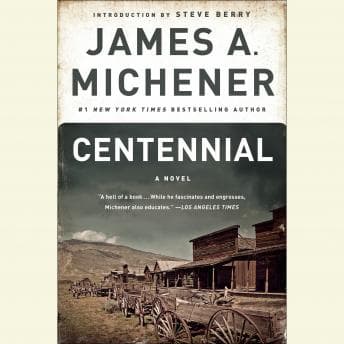

"The earth was ancient..." That's roughly how Michener opens this thing — not with people, not with dialogue, but with the literal formation of the Rocky Mountains. Millions of years of geological upheaval before a single human being shows up. I was sitting on my apartment floor at 1 AM, surrounded by half-unpacked board games from a failed game night (nobody showed), and Michener had me genuinely invested in sedimentary rock layers. That's either a sign of his genius or my complete lack of a social life. Probably both.
Fifty Hours of Geological World-Building and I'm Not Even Mad
Let me be honest with you: this audiobook is 50 hours and 12 minutes long. Yes, it's 40 hours. Yes, it's worth it. (Okay, it's actually 50. Even more worth it? Debatable.) But here's the thing — Michener doesn't write novels the way most people write novels. He writes entire civilizations. Centennial starts with dinosaurs. Actual dinosaurs. Then it moves through the formation of the land itself, the arrival of Indigenous peoples, the fur trade era, westward expansion, cattle ranching, sugar beet farming, water rights disputes, and eventually lands in the 1970s. Each section is basically its own novella with its own cast, connected by the fictional town of Centennial, Colorado and the land it sits on.
This is Sanderson-level world-building, except instead of investiture and Shardblades, it's aquifers and grazing rights. And somehow it works. The magic system is chef's kiss — except the magic system is just... American history, rendered with obsessive geological and ecological detail. Michener spent years researching this. You can tell. The man probably knew more about rattlesnake migration patterns in the Platte River valley than any novelist has a right to know.
The standout sections for me: Lame Beaver's story as an Arapaho warrior genuinely hits different. There's a scene involving a raid on a Comanche camp that's visceral and complicated — Michener doesn't romanticize Indigenous life but he also doesn't reduce it to noble savage nonsense. He lets it be messy and human. Then there's Levi Zendt, the Amish kid who flees east with his child bride, and the way Michener tracks his transformation from sheltered farm boy to frontier survivor over hundreds of pages is the kind of slow-burn character progression that scratches the same itch as a good LitRPG. The progression is satisfying. You watch this guy level up in real time across decades.
And Jim Lloyd falling for Charlotte Seccombe — a cowboy and an educated Englishwoman — could've been pure melodrama, but Michener makes it ache because he's already spent 30 hours teaching you what that land costs people. You understand the weight of what they're choosing.
Fair warning though: if you don't like info-dumps, this isn't for you (but you're wrong). There are chapters that are essentially essays on cattle breeding or irrigation law wearing a thin fiction disguise. I read this instead of writing my thesis, which is ironic because some of these chapters feel like reading someone else's thesis. Michener will spend 40 pages on the economics of open-range ranching. I loved it. My D&D group would love this — it's basically a setting guide for a Western campaign with a 500-year timeline.
Larry McKeever: Competent but Not Memorable
Here's where I have to be straight with you. Larry McKeever reads this book. He reads it competently. He reads it clearly. And that's... kind of it. Steven Pacey walked so other narrators could run, and McKeever is sort of standing still. He's not bad — his pacing is steady, his enunciation is clean, there's no audio weirdness or production problems. But across 50 hours with dozens of distinct characters spanning centuries and multiple ethnic backgrounds, I never once felt like I was hearing different people. Lame Beaver sounds like Levi Zendt sounds like Jim Lloyd. For a book THIS sprawling, that's a real missed opportunity. You're asking listeners to commit to over two full days of audio — give me something to grab onto vocally. A hint of an accent. A shift in cadence for the Arapaho sections versus the German-immigrant sections. Something.
It's professional. It's fine. It's not what this book deserves.
Who's Got 50 Hours and a Love of Dirt?
If you're the kind of person who reads the appendices in Tolkien, who watches Ken Burns documentaries for fun, who thinks the best part of a fantasy novel is the map — this is your book. If you want tight plotting and snappy dialogue, run away. This is a novel about land and time and what happens when people collide with both. It rewards patience like few books I've encountered.
Some Michener fans rank it below Chesapeake or Alaska or The Covenant. I can't speak to those yet (they're on the list, right after I finish Rhythm of War for the third time and definitely before I finish my thesis). But as a standalone experience, Centennial gave me something most fiction doesn't: a genuine sense of deep time. Of scale. Of how thin our little human dramas are against the rock and the river. That feeling of smallness against vast, indifferent forces — Plato was wrestling with similar ideas about perception and reality thousands of years ago, and listening to Allegory of the Cave: An Excerpt from The Republic hit me with that same existential vertigo, just compressed into a much shorter runtime.
Roll for History Check
Spend the credit on the book itself — the writing carries it even when the narration doesn't elevate it. But go in knowing this is a marathon, not a sprint, and your narrator is less "dramatic performer" and more "very competent History Channel documentary voice." For 50 hours, that gap matters. I wish someone like Scott Brick or even a full cast had gotten their hands on this. The source material is too good for just-okay delivery.
Still. I listened to the whole thing. And I thought about Lame Beaver's story for days after. That counts for a lot.