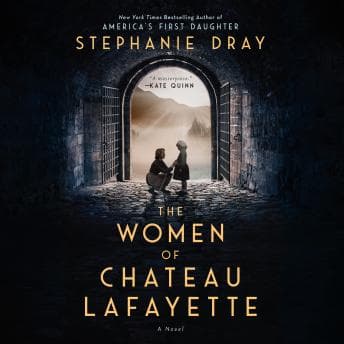

Twenty-four hours. TWENTY-FOUR HOURS of audiobook and Stephanie Dray really thought I wasn't going to need a full box of tissues? I'm sorry but the AUDACITY.
I started this on a random Tuesday while designing wedding invitations for a client who wanted "elegant but not boring" (the most cursed brief in existence), and by hour three I had to switch to something less emotionally devastating because I couldn't see my screen through the tears. Frida kept headbutting my elbow like she knew. She knew.
Three Women, One Castle, Zero Emotional Boundaries
Here's what got me: this isn't just historical fiction doing its usual "look at these Important Events" thing. Dray connects Adrienne Lafayette in the French Revolution, Beatrice Chanler during WWI, and Marthe Simone in Nazi-occupied France—and somehow makes all three feel like women I could have coffee with. Or wine. Definitely wine for Beatrice, that woman had ENERGY.
The structure could have been a mess. Three timelines, three protagonists, jumping back and forth across centuries. But Dray anchors everything to this castle—Chavaniac—and it becomes this living, breathing thing that ties these women together across time. When Marthe discovers something about her own identity late in the story, it hit me so hard I had to pause and just... sit with it. My abuela would have loved this one. She always said the women in our family carry the weight, and these women? They carry EVERYTHING.
The Narrator Trio That Actually Works
Three narrators for three timelines sounds like a recipe for whiplash, but Emma Bering, Rachel L. Jacobs, and Tavia Gilbert make it work. Really, genuinely work. Each narrator owns her timeline so completely that the switches feel natural rather than jarring.
Tavia Gilbert's Adrienne has this quiet steel underneath the aristocratic French accent—you can hear her becoming radicalized, becoming brave. Rachel L. Jacobs gives Beatrice this crackling American socialite energy that softens into something more wounded as WWI devastates everything she thought she understood. And Emma Bering's Marthe? The emotional delivery when she's processing the Nazi occupation, the fear and the slow awakening to resistance... I ugly-cried at least twice during her sections.
The stress and hard times were clearly felt through the narration—not performed at you, but lived. That's the difference between good audiobook narration and great audiobook narration.
The Commitment Is Real (But Worth It)
I'm not going to lie to you: this is a COMMITMENT. Almost 24 hours means you're spending serious time with these women. There are moments where the historical detail gets dense—Dray clearly did her research on the French Revolution and both World Wars, and sometimes you feel every bit of that research. If you're looking for something light to half-listen to while doing dishes, this ain't it.
But if you want to feel like you've actually LIVED through something? If you want to understand how ordinary women become extraordinary through impossible circumstances? Clear your schedule. This is a rainy Sunday book—or more accurately, a rainy Sunday MONTH.
I listened at my usual 1.0x because rushing through this felt wrong. These women deserve the full experience.
Who Gets to Cry With Me (And Who Should Sit This One Out)
This is for you if: you love historical fiction that centers women's experiences without making them passive observers, you can handle complex timelines, you want to ugly-cry at least three times, or you've ever wondered what courage actually looks like when it's not convenient.
Skip if: you need fast pacing, you want something light, or you're not ready to feel things about the French Revolution AND World War I AND World War II in one book. That's a lot of historical trauma, friends.
My Heart, Permanently Rearranged
I finished this at 2 AM, Diego asleep on my keyboard, client deadline completely forgotten. Some books entertain you. Some books move you. This one? This one changed something in me. Daisy Jones & The Six did that too—that rare thing where you finish and realize you're not quite the same person who started it. The vibes are immaculate, if "immaculate" means "devastating and hopeful in equal measure."
The chemistry between the women and their respective causes, their loves, their impossible choices—chef's kiss. My heart. MY HEART.
Stephanie Dray made me care about the Marquis de Lafayette's wife, a WWI-era socialite, and a WWII orphan-turned-teacher, and somehow convinced me they were all connected to each other and to me. That's not just good writing. That's magic.