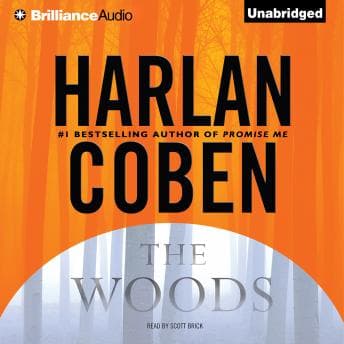

"My sister went into the woods and never came out."
That line - or something damn close to it - hits you early in this book, and it stuck with me through a late Saturday night cleaning my Beretta at the kitchen table. Linda was asleep, Ranger was curled up by my feet, and Harlan Coben had me sitting there with a dirty bore brush in one hand and my jaw on the floor.
Let me cut to the chase: The Woods is a solid thriller that earns its twists honestly. Not perfect, but worth your time.
A Prosecutor Who Can't Stop Digging His Own Grave
Paul Copeland is a New Jersey county prosecutor still haunted by summer camp in 1994, when his sister Camille and three other teenagers walked into the woods during a late-night party and two of them turned up dead. Camille and a boy named Gil Perez never turned up at all. Twenty years later, a body surfaces that might be Gil Perez - which cracks open the possibility that Camille could still be alive.
Coben layers this thing like an onion. You've got Cope's day job prosecuting a rape case involving privileged college kids, his Russian immigrant father's mysterious past, a romance with a fellow widowed parent, and the central cold case - all running simultaneously. The man juggles subplots like a combat staff officer managing battle rhythm. Most of the time it works. Occasionally you feel like one thread gets neglected for three chapters before snapping back.
What I appreciated is that Cope isn't some genius detective. He's a grieving brother who makes emotional decisions that a trained prosecutor should know better than to make. He walks into situations without backup, literally and figuratively. I've seen this scenario play out in real life - grief makes smart people stupid, and Coben nails that dynamic without making Cope unlikable.
The family secrets angle involving Cope's father and their immigration story from the Soviet Union adds real weight. This isn't just a whodunit. There's a generational trauma thread running through it that caught me off guard. The things parents hide to protect their children - and the destruction those secrets cause decades later - that hit different for me. (My old man never talked about Korea. I get it.)
Scott Brick Does the Heavy Lifting
Scott Brick narrating a thriller is like putting a seasoned NCO in charge of a platoon - you know the mission's going to get executed. The man has won something like thirty Earphone Awards and you can hear why. His Cope is measured, tired, carrying weight - exactly right for a widower prosecutor who's been running from 1994 his whole life.
Where Brick really earns his pay is the emotional delivery. There are revelation moments in the back half of this book - genuine "oh my god" turns - and Brick doesn't oversell them. He lets the writing do the work and just provides the right amount of tension in his voice. That restraint is harder than it sounds.
One gripe I've seen floating around: the phone call narration. There are sections where characters are talking on the phone and Brick's approach to distinguishing the voices gets a little muddy. It's not a dealbreaker, but around hour seven or eight when multiple phone conversations are advancing the plot, I did have to rewind once to figure out who said what. At 1.25x speed, that's on me as much as him. But it's worth flagging.
His character differentiation is solid otherwise. The Russian father sounds distinct from the Jersey lawyers who sound distinct from the college kids in the rape case. Nothing theatrical - just enough variation that your brain tracks who's talking.
Where Coben Loses a Step
This is where it lost me, at least partially. The final reveals pile up fast. Coben's known for his twists, and I count at least three major ones in the last two hours. The first one? Genuinely didn't see it coming. The second? Strong. The third starts to feel like he's showing off. At some point, you need to trust your best punch and stop throwing haymakers.
Also - and this is a content warning for folks who need it - the story gets dark. The rape case subplot involves some graphic testimony, and the violence escalates as the truth about the woods comes out. I'm not squeamish (Fallujah, remember), but I can see how some listeners might find certain passages gratuitous rather than necessary.
The pacing across 12 and a half hours is mostly tight. Coben keeps chapters short, which works beautifully in audio format. But there's a stretch in the middle - maybe hours five through seven - where the romance subplot slows things down more than it should. Linda would probably disagree with me on that one.
Who Should Gear Up For This
If you like Coben's other stuff - Tell No One, Gone for Good - you know exactly what you're getting and you'll be happy. If you want a thriller that's more than just plot mechanics, the family dynamics and immigrant backstory give this real substance. Road trips, commutes, long runs - it works for all of them because the chapter structure keeps feeding you reasons to stay.
Skip this if gratuitous twist endings frustrate you, or if you need your thrillers to stay in one lane. Coben's juggling act will either thrill you or exhaust you. On the other end of the thriller spectrum, Daniel Silva's The English Assassin runs a tighter operation — fewer subplots, more focused tension — and that restraint worked well for me too.
Mission Debrief
Ranger slept through the last three hours, but I didn't. The Woods is a damn good thriller with a knockout first twist, a strong narrator, and enough emotional depth to stick with you past the final chapter. It's not Coben's absolute best - he overplays his hand at the end - but it's close. Worth your time and your credit.