
I have a stack of thirty essays on The Great Gatsby sitting on my dining room desk right now. They've been there since Tuesday. They are staring at me, judging me, whispering about the decline of the American Dream.
Principal Martinez, if you're reading this—I'm sorry. But also, I'm not sorry. Because I spent the last three nights ignoring the Jazz Age to drift down the Gilead River in a canoe with four orphans.
(And honestly, grading can wait. My emotional stability needed this win.)
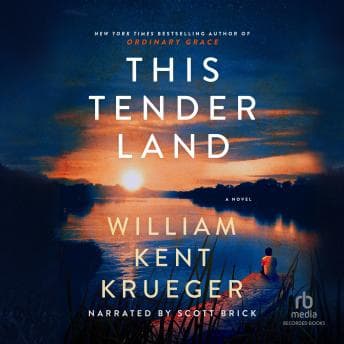
Here's the thing about This Tender Land—it is unapologetically old-fashioned. It's the kind of storytelling that feels like it should be read aloud by a grandfather while a fire crackles in the background. It's 1932. The Great Depression is in full swing. We have Odie O'Banion and his brother Albert escaping the Lincoln Indian Training School—a place that is exactly as horrific as it sounds—and heading for the Mississippi.
If that sounds familiar, it's because William Kent Krueger is basically rewriting Huckleberry Finn mixed with The Odyssey. As an English teacher, this is usually where I roll my eyes and start docking points for lack of originality. But I didn't. I just let it wash over me. The prose deserves to be savored, and frankly, I needed a journey that wasn't just a commute on the L train.
The Scott Brick Question
Let's be real for a second. We need to talk about Scott Brick.
In the audiobook world, this guy is like cilantro. Or maybe licorice. You either think he's the greatest living narrator, or you think he sounds like he's reading a eulogy for a ham sandwich. He has this breathless, dramatic delivery where every single sentence is treated like it holds the secrets of the universe. He does the exact same thing in Jurassic Park: A Novel, and honestly, it works there too—turns out dinosaurs also deserve gravitas.
Usually? That drives me nuts. I'm a "less is more" guy. I tell my students all the time—let the text do the work.
But here's the exception that proves the rule.
Krueger's writing is lush. It's big. It's emotional. It's practically begging for a performance, not just a reading. When Brick reads Odie's narration, that slight tremor in his voice, that folksy cadence—it fits. It fits perfectly. Brick brought that same emotional weight to Great Influenza: The Epic Story of the Deadliest Plague in History, though obviously with less harmonica and more epidemiology. He captures the melodrama of being a young boy who sees the world as a giant, mythical place. If you listened to this at 1.5x speed (you monsters know who you are), you'd miss the rhythm. The narrator understands that pause is punctuation.
There were moments—specifically a scene involving a harmonica and a campfire—where Brick's delivery actually elevated the text. He made me buy into the sentimentality when I might've rolled my eyes reading it on paper.
A Modern Odyssey (With Less Greek, More Minnesota)
This reminds me of what Hemingway said about all American literature coming from Twain. This book is the spiritual successor to Huck Finn, but without the biting satire. It's softer. It's about the search for home.
We follow these kids—Odie, Albert, Mose (a mute Native American boy), and little Emmy—as they encounter the best and worst of humanity. Faith healers, struggling farmers, displaced families. It's a road trip novel, but on water.
The audio format shines here because of the dialect work. Brick manages to give distinct voices to a massive cast without it turning into a cartoon. His women's voices are... okay, they're a little breathy, but his "old soul" voice for Odie anchors the whole thing.
(Side note: I listened to the last two hours while walking the lakefront with Denise. She asked me why I was sniffling. I told her it was the wind off Lake Michigan. It wasn't. It was the ending of this damn book.)
The Verdict
Look, my students would probably hate this. They'd call it "cringe" or "try-hard" because it wears its heart on its sleeve. It's sincere in a way that feels almost foreign in 2024.
But that's exactly why I couldn't stop listening. It's a big, sprawling, warm hug of a novel. It's violent at times, sure—the abuse at the school is hard to hear—but the overarching feeling is hope.
Who should listen: Anyone craving earnest, old-fashioned storytelling—the kind that believes in goodness without irony. If you want to feel like you're sitting on a porch in 1932 listening to a survivor tell his tale, this is your book. Who should skip: If you prefer dry, British detachment or can't stand Scott Brick's dramatic style, steer clear.
Just be warned: Brick's style is heavy. But if you're ready to let a story sweep you downstream?
Press play.
(Don't actually pause the faculty meeting for it, though. Martinez is watching.)