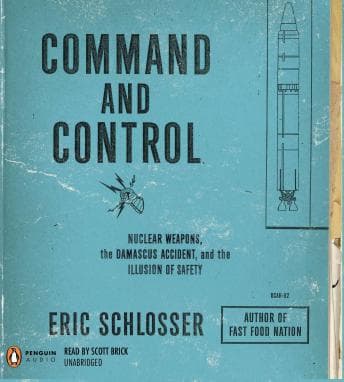

"We came close. Closer than anyone told you."
That's not a direct quote from the book, but it's the sentence that kept running through my head during the long drive back from San Antonio last Tuesday. Ranger was asleep in the back seat. I had the AC cranked and Scott Brick in my ears, and somewhere around the two-hour mark I had to pull into a gas station just to sit with what I'd just heard about the 1980 Damascus, Arkansas accident - a Titan II missile, the most powerful nuclear warhead the U.S. ever built, sitting in a silo while a maintenance crew tried to figure out what to do after a dropped socket wrench punctured the fuel tank. A wrench. A nine-pound socket wrench.
I've been in enough operational environments to know that complex systems fail at the seams - not at the big dramatic points, but at the stupid, mundane, Tuesday-afternoon moments nobody planned for. Schlosser gets that. The author clearly did their homework, and not just the declassified-document homework. He gets the institutional psychology of it. The way safety concerns got buried because admitting a problem meant admitting vulnerability. The way the Air Force and the civilian leadership spent decades playing a shell game with accountability while warheads sat on alert status with safety mechanisms that, in some cases, were deliberately bypassed to make the weapons more responsive.
That part hit different for me. I've operated under command structures where the pressure to project readiness overrode common sense. I've seen this scenario play out in real life - not with nukes, thank God, but the organizational dynamics Schlosser describes are identical to every institutional failure I witnessed in 25 years. The people at the bottom knew. They always know. And the information dies somewhere in the middle. I ran into that same institutional wall reading With All Due Respect — different arena, same buried truth.
What Twenty Hours of This Does to Your Brain
Let me cut to the chase on the structure: Schlosser alternates between the minute-by-minute Damascus accident narrative and a sweeping 50-year history of U.S. nuclear weapons policy, accidents, and near-misses. On paper that sounds like it could lose momentum. It doesn't. The Damascus thread is genuinely tense - you know it's history, you know the rough outcome, and it's still tense. That's craft.
The historical sections are where this book earns its Pulitzer finalist status. Schlosser walks through incidents that were classified for decades - broken arrows, accidents where weapons were dropped, burned, submerged, scattered across Spanish farmland. The Palomares incident in 1966 alone should've been front-page news for a generation. Four hydrogen bombs, one plane crash, and the U.S. government quietly buying contaminated Spanish soil by the barrel. The detail that the safety mechanisms on some of those weapons were in the "safe" position only because of a single low-voltage switch - one switch - between an accident and a detonation over North Carolina... I had to rewind that section twice.
Scott Brick handles the material well. His pacing in the Damascus sections is appropriately controlled - he doesn't oversell the tension, which is the right call because the facts are doing the heavy lifting. The technical passages, which could've become a slog, stay clear. No significant complaints on the narration front. At 1.25x he's still completely intelligible, which is my baseline test for any narrator on a 20-hour commitment.
The Thing Schlosser Is Really Arguing
This is where I want to push back slightly on the consensus take, which tends to frame this as a history book. It's not, really. It's an argument. Schlosser's thesis is that the safety of the U.S. nuclear arsenal has always been, to some degree, a performance - a confidence display for domestic politics and Cold War posturing, not an engineering reality. The title isn't metaphorical. "Command and Control" is the actual doctrine, and his point is that we never fully had either.
For listeners who want a comfortable reassurance that smart people had it handled: this book will not give you that. For listeners who've spent time inside large bureaucratic systems where the official story and the operational reality diverge significantly - you will find this book uncomfortably familiar.
Who should skip it: anyone wanting a quick listen or something they can half-follow while doing something else. This is a focus listen. Twenty hours of dense material that rewards attention. If you want the highlights, the documentary exists. But the documentary doesn't give you the full institutional archaeology that makes this genuinely important.
Cleared Hot
Ranger slept through most of it, which I'm choosing to interpret as calm confidence rather than boredom. I've been in uniform, I've operated near classified systems, and I still learned things from this book that made me uncomfortable in the best possible way. The Damascus accident thread alone is worth the runtime. The fifty years of institutional dysfunction surrounding it makes it essential.
Mission accomplished, Schlosser. Reluctantly, but completely.






![Steve Jobs [unabridged audiobook] audiobook cover](/_next/image?url=https%3A%2F%2Fcovers.audiobooks.com%2Fimages%2Fcovers%2Ffull%2F9788499923406.jpg&w=1920&q=75)