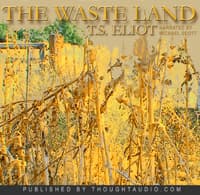

Twenty-six minutes. That's literally less time than I spend staring at the ceiling during a faculty meeting wondering if the coffee is decaf or just terrible.
Most people—my students included—treat The Waste Land like it's a bomb that needs defusing. They approach it with tweezers, terrified of the footnotes, trying to figure out which line is Greek and which one is just Eliot being pretentious. But here's the thing: T.S. Eliot didn't write this to be dissected like a frog in biology class. He wrote it to be heard.
I listened to this version on a Tuesday night, grading a stack of essays that were making me question the future of literacy. It felt appropriate. (If you know the poem, you know the vibe.)
Why Reading It Is the Hard Way
Look, I've been teaching high school English for two decades. I love books. Physical books. The smell of old paper. But reading The Waste Land on the page is... heavy. You're constantly flipping to the back for notes, trying to parse the Sanskrit, getting lost in the abrupt shifts from a pub in London to a mythical wasteland.
Audio changes the game entirely. Seriously.
When you listen, you don't have to worry about the formatting. You just let the voices wash over you. The fragmentation—which looks chaotic on paper—sounds like a radio dial spinning between stations. One minute you're hearing a high-society woman complaining about her nerves, the next you're in a pub hearing gossip about abortion pills. It flows. It makes sense in your ears in a way it never quite does in your eyes.
Michael Scott (No, Not That One)
Let's address the elephant in the room: the narrator is named Michael Scott. (Insert The Office joke here. My students would've had a field day.)
But this Michael Scott? He brings the gravitas. He understands that this poem is basically a collection of ghosts talking over each other. His delivery is clear, which is crucial because Eliot's syntax is a nightmare. He hits the dramatic beats without chewing the scenery too much.
There's a section—the "Game of Chess" part—where the tone has to shift from regal to desperate to vulgar pretty quickly. Scott navigates those turns without giving you whiplash. He treats the pauses like punctuation. That's the mark of a narrator who actually did the homework. He brings that same careful attention to Book of Revelation, though honestly, apocalyptic visions are a bit easier to follow than Eliot's fragmentary chaos.
He nails the "Shantih shantih shantih" ending. It didn't feel forced. It felt like a dying breath, which is exactly what it should be.
The "Unreal City" Vibe
I took a walk by the lakefront while finishing the last ten minutes. Chicago in November is basically the spiritual home of this poem. Gray, windy, kind of beautiful in a miserable way.
Listening to Scott read about the "brown fog of a winter dawn" while looking at the actual fog over Lake Michigan? That's an experience you can't get sitting at a desk. It reminded me why we still bother with these "ancient" texts. Eliot was capturing a world that felt broken, fragmented, and loud. Sound familiar?
(Don't tell Principal Martinez, but I think this 26-minute listen did more for my understanding of Modernism than four years of grad school seminars.)
Who This Is For (And Who Should Run)
If you've ever felt intimidated by Eliot, or if you read this in college and hated every second of it, try the audio. It's short. It's intense. It's a performance piece, not a puzzle. Skip it if you need something uplifting—this is not that.
Is it cheerful? Absolutely not. It's a downer. But it's a beautiful, rhythmic, necessary downer. And sometimes, especially after grading thirty papers on The Great Gatsby, that's exactly what you need.