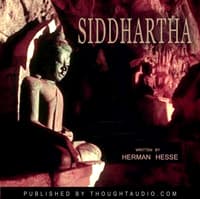

I'll be honest with you. I've taught Siddhartha probably fifteen times over the years. Watched students roll their eyes at it, watched a few of them actually get it, watched one kid cry during the river scene—which, if you know the book, you understand why. So when I finally decided to listen to it instead of reading it for the hundredth time, I wasn't sure what to expect.
Michael Scott's narration? It's exactly what this book needs. And I don't say that lightly.
Here's the thing about Siddhartha—it's not a plot-driven book. It's a meditation. Hesse wrote it like someone breathing slowly, deliberately, each sentence carrying the weight of a man trying to figure out why he exists. You can't rush that. You shouldn't want to. And Scott seems to understand this instinctively. His pacing is... patient. That's the word. He gives the prose room to exist.
I listened to most of this walking the lakefront with Denise. She was doing her own thing on her phone, and I had my earbuds in, watching the waves hit the rocks while Siddhartha sat by his river. There's something almost too perfect about that pairing—the water in my ears and the water in front of me. The narrator's voice is soothing without being sleepy, meditative without becoming monotonous. That's a harder balance than people realize.
What Hesse Was Really After
Hesse wrote this in 1922, between the wars, when Europe was spiritually exhausted. He was reaching toward Eastern philosophy not as appropriation but as genuine seeking. The audiobook format—specifically with Scott's delivery—actually enhances this. When Siddhartha rejects the Buddha's teachings, not because they're wrong but because he has to find his own path, Scott's voice carries this quiet conviction. No drama. No theatrical emphasis. Just a man choosing himself, for better or worse.
The narrator understands that pause is punctuation. There are moments in this recording where the silence between sentences does as much work as the words themselves. During Siddhartha's time with Kamala, with the merchants, with his own despair—Scott shifts his tone so subtly you almost don't notice it happening. But you feel it. The emotional landscape changes, and you're carried along with it.
(My students would hate this. They want action. They want things to happen. I love it.)
A Sit-Down-and-Be-Present Kind of Listen
At just under five hours, this is basically a long afternoon or a few commutes. It's not demanding your life. But it is asking for your attention. I wouldn't recommend this for the gym or for background noise while grading papers. Maybe that's the point. Scott brings that same intentional stillness to Art of War, though the subject matter couldn't be more different. Maybe Hesse would appreciate the irony—a book about presence requiring you to actually be present.
I should mention: some listeners apparently found the narration style didn't work for them. I get it. If you're coming to this expecting dramatic character voices or high energy, you'll be disappointed. This is a single narrator reading a philosophical novel with the restraint it deserves. If you loved The Prophet or anything by Thich Nhat Hanh, this is its spiritual successor in audiobook form. Anxious for Nothing occupies similar contemplative space, though it comes from a Christian rather than Eastern perspective.
The prose deserves to be savored. Hesse's sentences are simple on the surface but layered underneath. "The river has taught me to listen." That's the kind of line that hits differently when spoken aloud by someone who understands its weight. Scott doesn't oversell it. He just... delivers it. And you sit with it.
I listened at 1.0x because—well, you know my position on speed. The author chose those words. The narrator chose that pacing. Who am I to mess with it?
Production quality is clean. No weird background noise, no jarring edits. Just the voice and the story. Exactly what you want.
Who This Is (and Isn't) For
Skip this if you need plot momentum or dramatic vocal performances—you'll be bored within twenty minutes. But if you're the type who reads poetry slowly, who doesn't mind a book that asks more questions than it answers, who maybe needs a reminder that stillness isn't the same as stagnation? This one's yours.
Class Dismissed
This reminds me of what Hemingway said about prose being architecture, not interior decoration. Scott's narration is architectural. It supports the structure without calling attention to itself. That's performance art, honestly. Making the invisible visible without anyone noticing you're doing it.
Worth pausing the faculty meeting for? Absolutely. Principal Martinez can wait. The river is speaking.