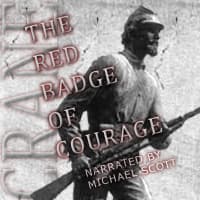

I honestly went into this one with my guard up.
I was driving out to a client site near Round Rock—boring perimeter check, easy money—and I needed something to kill the windshield time. I picked The Red Badge of Courage because it's a classic, sure, but mostly because I wanted to see if it held up. Here's the thing that usually grinds my gears: Stephen Crane wrote this book when he was 23 years old. He had never seen a battlefield. Never heard a shot fired in anger. Never smelled cordite or felt that specific, stomach-dropping sensation when the air starts snapping around you.
So, naturally, I was ready to roll my eyes at every inaccuracy. I spent half my life in uniform; I can spot a fake from a mile away.
But about twenty minutes in, I had to shut up and just listen.
The "Fog of War" Check
Let's be real for a second. Most war stories written by civilians focus on the wrong stuff. They obsess over the glory or the strategy or the specific model of a musket. Crane doesn't do that. He focuses on the confusion. The absolute, total chaos.
Henry Fleming, the main kid (and he is a kid), isn't a hero. At least not at first. He's terrified. He runs. And look—I've seen guys freeze. I've seen the panic set in when the plan goes out the window (and the plan always goes out the window). Crane captures that psychological spiral better than half the memoirs I've read written by guys who were actually there.
There's this sense of isolation Crane nails. You're surrounded by your regiment, but when the bullets start flying, you're completely alone in your own head. The narrator, Michael Scott, does a hell of a job with this. He doesn't make Henry sound like a coward, exactly. He makes him sound human. He captures that frantic internal monologue—the "fight or flight" switch jamming in the "flight" position.
(Ranger, my German Shepherd, slept through the fleeing parts. He prefers the action. But even he perked up during the flag-bearer scenes.)
The Voice in the Headset
Speaking of Michael Scott—no, not the guy from The Office, though that would've been a very different audiobook—he plays it straight.
His style is dramatic but clear. He's got that old-school, classic narration vibe. You know the type? The kind that sounds like it should be coming out of a mahogany radio. It works here.
Since the book is short (under 5 hours), the pacing is crucial. I listened at my usual 1.25x, and it moved at a good clip. Scott handles the transition from Henry's shame to his eventual "redemption" without being melodramatic about it. He lets the text do the heavy lifting.
There's a lot of biblical imagery and symbolic stuff in Crane's writing—sun looking like a wafer, monsters, dragons, that sort of thing. If the narrator isn't careful, that stuff can sound pretentious. Scott grounds it. He makes it sound like the fever dream of a terrified soldier, which is exactly what it is.
He brings that same grounded intensity to War of the Worlds, though that's a different kind of terror entirely.
Where It Might Lose You
Now, don't get me wrong. It's not perfect.
If you're looking for a tactical breakdown of the Battle of Chancellorsville (which is what this is loosely based on), you're going to be disappointed. There are no maps here. No clear "we flanked them on the left" moments. It's impressionistic. It's a mood.
The dialogue can be a bit... thick. Crane wrote the soldiers speaking in heavy vernacular dialect. "Yeh" instead of "You," that kind of thing. Reading it on paper can be a headache. Listening to it is actually way better because Scott smooths out the rough edges, but it still sounds a little caricatured at times.
If you're like my wife Linda and you want a clear hero who does everything right and saves the day with a smile, Henry Fleming is going to annoy the hell out of you. He's whiny. He rationalizes his cowardice. He's a mess. But that's the point.
The Debrief
I sat in my truck for an extra ten minutes after I parked just to finish the last chapter.
For a guy who never saw combat, Crane understood something fundamental: bravery isn't the absence of fear. It's functioning in spite of it. And he understood that sometimes, the difference between a hero and a coward is just a matter of timing and luck.
Sergeant York and His People wrestles with that same question from the other side—what happens when a man of faith has to reconcile his beliefs with what war demands of him.
It's a short listen. It's intense. And for a book written in 1895, it feels uncomfortably modern in its psychology.
Who should listen: Anyone who wants to understand the psychological reality of combat—the fear, the shame, the chaos—rather than the Hollywood version. Who should skip: If you need tactical clarity or a straightforward hero arc, this isn't your mission.
Just don't expect a history lesson. Expect a gut check.






![Steve Jobs [unabridged audiobook] audiobook cover](/_next/image?url=https%3A%2F%2Fcovers.audiobooks.com%2Fimages%2Fcovers%2Ffull%2F9788499923406.jpg&w=1920&q=75)