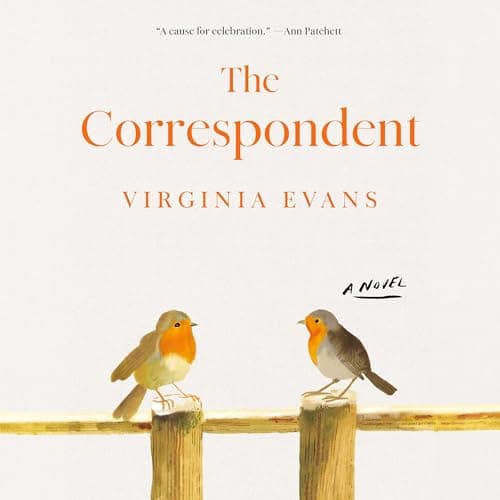

Can we talk about the address headings? Because I need to get this off my chest before anything else. Every single letter in this audiobook opens with the full address being read aloud. Every. Single. One. And later, when emails enter the picture, you get to hear email addresses narrated character by character. It's the audiobook equivalent of someone reading you the return address on every piece of mail before letting you see what's inside the envelope. I nearly threw my headphones across the room during a morning walk before I made peace with it and just... let it happen.
Now that I've vented, let me tell you why I kept listening despite that quirk, and why I think most of you should too.
Virginia Evans has written something genuinely rare — an epistolary novel that feels alive, populated by a protagonist who is simultaneously infuriating and magnificent. Sybil Van Antwerp is the kind of woman who writes letters to Joan Didion about what she thinks of her latest book, fires off correspondence to university presidents demanding audit privileges, and maintains decades-long friendships through the postal service. She's sharp, opinionated, sometimes cruel, and achingly human. The kind of character you argue with in your head while simultaneously recognizing her as someone you'd want at your dinner table.
The story unfolds through Sybil's letters — to her brother, her best friend, public figures, and crucially, to one unnamed person she writes to repeatedly but never sends the letter. When correspondence from her past surfaces and forces her to reckon with a painful chapter of her life, the novel shifts from charming character study into something much heavier and more urgent. There's a funeral scene where Sybil delivers a eulogy while simultaneously processing a threatening letter that had me sitting in my parked car, engine off, unable to move until it was over.
The audiobook production makes a bold choice: full cast narration. Maggi-Meg Reed anchors the whole thing as Sybil, and she is extraordinary. She captures Sybil's intelligence, her dry humor, her brittleness, and her buried tenderness with a performance that feels less like reading and more like channeling. The supporting cast — David Pittu, Mark Bramhall, Robert Petkoff, Kimberly Farr, and others — each make their correspondent feel like a fully realized person. When you hear a letter from Sybil's brother versus one from her best friend, they don't just sound different; they feel different. The emotional temperature of the room changes.
Here's where the audiobook format gets interesting, though. Some listeners have argued — and I see their point — that this particular novel works better on the page. The epistolary format includes crossed-out words, email formatting, and visual elements that lose something in audio translation. The address-reading issue I mentioned isn't trivial; it genuinely disrupts the flow. And a few listeners found that hearing Sybil's voice made her less sympathetic than reading her words on paper might have. There's something about the performative quality of a narrator that can tip a prickly character from charmingly difficult to just... difficult.
I land on the other side of that argument. The full cast adds a dimension that the page can't deliver. Hearing these letters performed — with pauses, with vocal breaks, with the subtle tremor in Reed's voice when Sybil approaches the subjects she's spent a lifetime avoiding — gave me an experience I don't think I would have gotten from reading. The letters aren't just words; they become conversations, confessions, performances within performances. When Sybil writes to someone she'll never send the letter to, you can hear the difference in Reed's delivery. It's quieter, less guarded, almost private. That distinction alone justifies the audio format.
Evans has written a novel about the hubris of youth and the hard-won clarity of age, about forgiveness as an act you perform for yourself rather than the person who wronged you. The pacing is deliberate — this is not a book that rushes. It accumulates, letter by letter, building a portrait of a life that is both extraordinary and recognizably ordinary. I cried during at least two sections, and I laughed out loud during Sybil's increasingly exasperated letters to institutional bureaucrats.
At just over eight and a half hours, it's the right length. Any shorter and you'd lose the cumulative power of watching a life unfold through correspondence. Any longer and the format might start to feel like a gimmick rather than a genuine artistic choice.
The comparison to 84 Charing Cross Road is apt — both novels find profound meaning in written correspondence and unlikely connections. My parents ran their dry cleaner on handshakes and loyalty — no letters, no paper trail — which is probably why I keep gravitating toward books that treat correspondence as its own kind of intimacy, and L.A. Weather scratched a similar itch for me, though it works through family dynamics rather than letters. But Evans is doing something more ambitious, using the epistolary form not just to chronicle a relationship but to map an entire life and its reckoning. Ann Patchett called it "a cause for celebration," and while I'm skeptical of blurbs on principle, she's right about this one.
Who should listen: If you love character-driven literary fiction, epistolary novels, or full-cast productions where the voice work genuinely elevates the material, this is a strong buy. If you need plot momentum or get irritated by format quirks — those narrated addresses, the occasional visual gag that doesn't land in audio — you might want to pick up the print edition instead.
This is a debut novel that reads like the work of someone who has been writing for decades and finally found the perfect vessel for her voice. Sybil Van Antwerp will stay with you — her letters, her silences, and especially the one letter she finally decides to send.