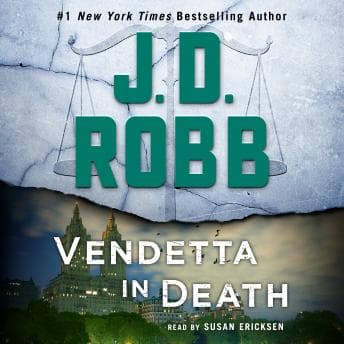

Look, I have a problem. Forty-nine books into a series and I'm still here, still listening, still analyzing Eve Dallas like she's one of my case studies. My therapist would have thoughts about this level of commitment to a fictional homicide detective.
But here's the thing about Vendetta in Death—it gave me exactly what I needed to justify my obsession. A vigilante calling herself Lady Justice? Who methodically targets men who've escaped consequences for their crimes against women? The moral complexity here is something I genuinely can't stop turning over in my head.
The Psychology of a Vigilante (And Why It Works)
What makes Lady Justice compelling is that she isn't just rage in heels. She's calculated. She transforms herself—tall blonde one night, curvaceous redhead the next—becoming whatever her target desires before making him pay. Research shows that revenge fantasies serve a psychological function, but J.D. Robb takes it somewhere darker and more interesting.
Nigel McEnroy, the first victim, kept records of his own crimes. Compulsive documentation of terrible behavior. I found myself asking: why does someone like that really keep evidence? Is it trophy-taking? A need to relive the power? The book doesn't spell it out, but it understands human nature well enough to let you wonder. Flicker in the Dark explores similar questions about how we rationalize our darkest impulses, though from a completely different angle.
Eve's investigation becomes this fascinating study in how we assign moral weight. Lady Justice is killing bad men. Really bad men. The kind who've used wealth and power to silence their victims. And Eve—who has her own brutal history with male violence—has to hunt her down anyway. That tension? Psychologically, it tracks perfectly.
Susan Ericksen Gets Inside Their Heads
I've been listening to Ericksen narrate this series during morning jogs through Cambridge for... longer than I care to admit. She's been the voice of Eve Dallas for so long that I genuinely can't imagine the character any other way.
Her Roarke still has that Irish lilt that makes my research brain go quiet for a second. (Don't tell my dissertation committee.) And she gives Eve this particular edge—not quite cold, but controlled. The kind of voice that belongs to someone who's compartmentalized trauma into something functional. It's spot on. That same controlled intensity shows up in Hidden, where the protagonist's past trauma shapes every investigative choice.
The challenge with a cast this large is differentiation, and honestly? Sometimes I lost track of which secondary character was speaking. With dozens of voices to maintain across nearly thirteen hours, there are moments where the distinctions blur. But Ericksen's emotional delivery during the heavy scenes—the confrontations, the revelations—never wavers.
Where the Formula Bends
I'll be real. This isn't the most surprising installment in the series. If you've been following Eve and Roarke since the beginning, you know the rhythms. You know how the investigation will unfold. You know they'll solve it.
But that's not really why I'm here forty-nine books in, is it?
I'm here because watching Eve navigate her own psychology while hunting someone whose motivations she might secretly understand—that's the good stuff. McEnroy's widow reacting with fury and denial instead of grief? Classic defense mechanism. The way the investigation forces Eve to confront questions about justice versus law? This is how procedural fiction can explore ethics without becoming preachy.
Some middle sections dragged—I definitely zoned out during one of my jogs and had to rewind—but when the tension ratchets up, Ericksen's delivery keeps you locked in.
Who's This For (And Who Should Skip)
If you're new to the In Death series, this isn't your entry point. You need the foundation—Eve and Roarke's relationship, Eve's history, the futuristic New York setting. Start at the beginning. But if you're already invested and want to watch Eve work through another case that challenges her own definitions of right and wrong? Vendetta in Death delivers exactly what it promises.
Case Closed (For Now)
Probably wouldn't relisten to this specific one, if I'm honest. But Susan Ericksen brings it home like she always does, and the psychological layers gave me plenty to chew on.
Just maybe don't listen during a jog when you're already overthinking your own research on revenge psychology. That's a lot of dark material for a Tuesday morning. Trust me on this one.