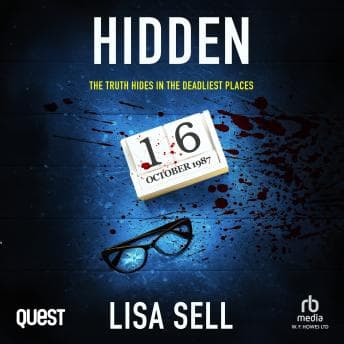

So here's the thing about guilt narratives in crime fiction - they're either psychologically rich case studies or they're manipulative shortcuts. Lisa Sell's Hidden falls somewhere in between, and I spent nine hours trying to figure out which side it landed on.
The premise hooked me immediately. Jen Taylor believes she killed her friend Kelly back in 1987. Not "might have been involved" or "feels responsible in that vague survivor's guilt way" - she genuinely believes she caused this girl's death. And then Kelly's mother asks her to help investigate the murder. The protagonist exhibits classic cognitive dissonance patterns here, and I found myself asking: why does Jen really agree to this? Is it penance? Self-destruction? A subconscious need to be caught?
These are the questions that kept me running an extra mile on my morning jogs.
The Psychology of Secrets (And Why This One Works)
What makes this character compelling is that Jen's secret isn't just plot machinery - it's identity. She's built her entire adult self around this buried trauma, and watching that construction start to crack as she digs into the past? That's good psychological territory. Sell understands that secrets don't just hide information. They reshape the person holding them.
The dual timeline structure - 1987 and present day - could have been clunky, but it actually serves the psychology well. Big Little Lies uses a similar technique to reveal how past choices ripple into the present, though Moriarty's ensemble cast creates more narrative complexity than Sell's single-POV approach. We see teenage Jen making decisions that seem inexplicable until we understand the social dynamics around her. The friendship with Claire, the relationship with Kelly, the pressures of being fourteen in a small community. The research actually shows that adolescent decision-making is heavily influenced by peer perception, and Sell captures that without being preachy about it.
Now, does every twist land? No. There's a second murder that feels more like a plot requirement than an organic development. And honestly, I saw one of the "shocking" reveals coming from about chapter three. But the emotional core - Jen's internal reckoning - held my attention even when the mystery mechanics got a little creaky.
The Voice in My Head
Melanie Crawley's narration is... interesting. And I mean that genuinely, not in the "bless her heart" way. Her delivery is clear and steady, which works for the measured, guilt-laden tone of the story. She doesn't oversell the emotional moments, which I appreciated - nothing worse than a narrator who treats every revelation like a soap opera cliff-hanger.
But here's where I have to be honest: I can see why some listeners found it soporific. Crawley's pacing is consistent. Very consistent. Almost too consistent. There's not a lot of dynamic range, and during some of the slower middle sections, I did find my attention drifting. (I may have missed a turn during one of my runs. Don't tell anyone.)
For me, the steady delivery worked because I was invested in the psychological layers. If you're coming to this for pure thriller adrenaline, though? You might struggle. This is a slow-burn mystery, not a page-turner that grabs you by the throat.
Where the Narrative Shifts
The book really finds its footing in the final third. Without spoiling anything, the investigation starts revealing that everyone from 1987 has secrets - not just Jen. And this is where Sell's character work pays off. These aren't cardboard suspects with convenient motives. They're people who've been carrying their own guilt, their own versions of what happened, for decades. All Good People Here explores similar territory with small-town secrets that have festered for years, though I found the character work there less psychologically convincing.
My therapist would have thoughts about this character - specifically about how Jen's need to control the narrative of Kelly's death mirrors how trauma survivors often try to "manage" their memories. It's not always accurate to what actually happened, but it feels true to the person experiencing it.
The ending mostly satisfied me. Mostly. There's one character arc that felt rushed, and I wanted more from the confrontation with Claire. But the resolution of Jen's central question - did she really kill Kelly? - is handled with more nuance than I expected.
Would I Listen Again?
Probably not, but that's not a criticism. This is a one-and-done thriller that delivers what it promises: a guilt-soaked mystery with solid character psychology and enough twists to keep you engaged. It's not going to revolutionize the genre, and it's not trying to.
Who Should Listen (And Who Should Skip)
If you're a fan of psychological thrillers where the protagonist's internal landscape matters as much as the external mystery, this is worth your time. If you need constant action and a narrator who performs every line like their life depends on it? Sample first - or skip entirely.
I listened to this during a week of particularly stressful faculty meetings, and honestly, it was exactly what I needed - engaging enough to distract me, psychological enough to satisfy my professional brain, not so demanding that I couldn't zone out during the boring parts.
That's not a ringing endorsement, I know. But it's an honest one.









