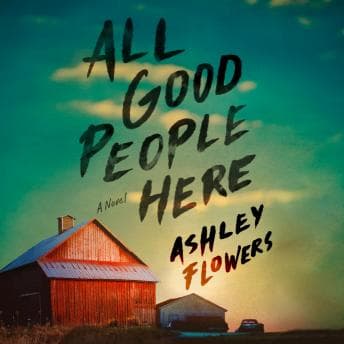

The Scene
I was halfway through a batch of dal makhani—the kind that requires actual attention, not the instant pot version my mother would disown me for making—when I realized I'd been standing at the stove for forty minutes without stirring. The onions had caramelized past the point of no return. Ashley Flowers had me that locked in.
Look, I came to this with some skepticism. True crime podcaster writes a novel? The research actually shows that expertise in one narrative form doesn't automatically transfer to another. (My dissertation committee would be proud I still cite "the research" while burning dinner.) But here's the thing: Flowers understands something fundamental about why we're drawn to stories about terrible things happening to children in small towns. It's not morbid curiosity. It's the terrifying recognition that evil doesn't announce itself. It looks like your neighbor. It waves at you from across the fence.
That's the same unsettling premise that makes Strange Case of Jekyll and Hyde so enduring—the monster isn't separate from us, it's woven into the fabric of respectability.
Margot Davies exhibits classic patterns of survivor's guilt mixed with what I'd call "proximity trauma"—she wasn't the victim, but she was close enough to feel like she could have been. Twenty years later, she's still running from Wakarusa, Indiana, while simultaneously being pulled back to it. Psychologically, this tracks. We return to our wounds. We pick at them. We tell ourselves it's about justice when really it's about making sense of randomness.
The Voices That Carry This
Three narrators. Three women. And honestly? It mostly works.
Brittany Pressley and Karissa Vacker are the heavy lifters here, and they've got the Earphones Awards to prove they know what they're doing. Pressley in particular nails the icy foreboding of the dual timeline structure—there's this quality to her delivery that feels like someone telling you a secret they're not sure they should share. The pacing is deliberate without being slow, which is harder than it sounds. (Trust me, I've listened to enough audiobooks where "atmospheric" becomes code for "I fell asleep during my commute and missed my exit.")
Now, the elephant in the room: no male narrator. Some listeners found the female narrators doing male voices distracting, and I get it. I do. Billy's voice in particular pulled me out a few times—not because the performance was bad, but because my brain kept going "that's a woman doing a man's voice" instead of just hearing Billy. It's a production choice, and your mileage will vary. For me, it was a minor annoyance in an otherwise solid audio experience.
Flowers herself narrates portions, and here's where it gets interesting from a psychological standpoint. She's not a trained voice actor. She's a podcaster. And you can hear that—there's a rawness, an intimacy that feels less "performance" and more "someone telling you about a case that keeps her up at night." Whether that works for you depends entirely on what you're looking for. I found myself asking: why does this feel different? And I think it's because Flowers isn't playing a character. She's doing what she does on Crime Junkie—walking you through horror with the kind of measured intensity that says "I've thought about this a lot. Too much, probably."
What Makes This Compelling (And What Doesn't)
The dual timeline structure is a fascinating case study in how we process trauma across generations. January Jacobs, 1994. Natalie Clark, present day. Two girls. Two disappearances. The parallels are obvious—maybe too obvious at times—but Flowers uses them to explore something I find genuinely interesting: how small towns metabolize their own darkness. Wakarusa isn't just a setting. It's a character. Genial, stifled, secretive. The kind of place where everyone knows everyone's business except the things that actually matter.
The protagonist exhibits classic journalist-as-detective patterns, which can feel formulaic if you've consumed enough of this genre. (I have. My Audible library is a crime scene.) But what makes Margot work is that she's not particularly good at this. She makes mistakes. She misses things. She lets her personal connection to the case cloud her judgment. Psychologically, this doesn't just track—it's refreshingly honest about how trauma compromises our ability to see clearly.
That said, let's talk about the ending. Because people have Opinions.
I'm not going to spoil it, but I will say this: if you need everything tied up with a bow, you're going to be frustrated. The resolution is... abrupt. Some threads dangle. Some questions remain. My therapist would have thoughts about this character—specifically about Margot's need for closure and whether the ending denies her (and us) that catharsis intentionally or just because the book ran out of pages. I genuinely can't tell. And I've been thinking about it for three days now, which is either a sign of a book that lingers or a book that didn't finish its job. Maybe both.
Who Should Listen (And Who Should Skip)
If you're a Crime Junkie fan, this is a no-brainer. The DNA is the same—the pacing, the reveals, the way Flowers builds dread through accumulation of detail. You'll feel at home here.
If you're coming to this cold, expecting a traditional thriller with a satisfying conclusion? Sample first. Seriously. The audiobook is over ten hours, and if that ending is going to infuriate you, better to know before you're emotionally invested.
Best for: morning jogs (kept me moving through Cambridge even when my lungs disagreed), commutes, any activity where you want to be absorbed but not so absorbed you forget to, say, stir your dal makhani.
Skip if: you're sensitive to violence against children (it's handled with restraint, but it's there), you need male narrators for male characters, or you're the kind of person who throws books across the room when endings don't satisfy. (I've done this. The book survived. My relationship with that author did not.)
Flowers understands human nature—specifically, the human nature of people who keep secrets, who protect monsters, who convince themselves that silence is the same as innocence. That's what stayed with me. Not the mystery itself, but the question underneath it: What are we capable of when we think no one is watching?
I'm still not sure I want to know the answer.









