
What would you actually trade your soul for?
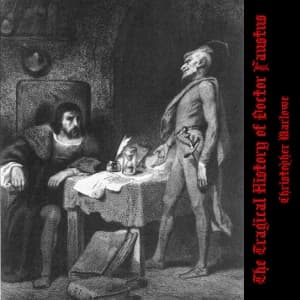
Not in the abstract, philosophical way. I mean really. What's your price? Because Christopher Marlowe wrote this play over 400 years ago and that question still hit me differently at 4 AM, sitting in a quiet trauma bay charting vitals on a patient who'd just coded, listening to a man barter away eternity for 24 years of unlimited power. The parallels between Faustus's hubris and some of the god-complex surgeons I've worked with were - honestly - a little too on the nose.
A 400-Year-Old Play That Still Knows How to Land a Gut Punch
So here's the thing. I don't usually reach for Elizabethan drama. My audiobook rotation is pretty firmly mystery/thriller/memoir territory. But at an hour and forty minutes, this felt like a palate cleanser between two medical thrillers that both got intubation wrong (don't get me started). And Marlowe? Marlowe delivers.
The setup is straightforward - brilliant scholar gets bored with conventional knowledge, summons a devil, signs a contract in blood, gets 24 years of demonic power. The execution is what gets you. Faustus doesn't use his cosmic abilities for anything truly grand. He torments the Pope. He conjures Alexander the Great as a party trick. He falls for Helen of Troy. He's basically a man with infinite credit and no plan, which - if you've ever watched someone blow through an inheritance - you know is the most realistic part of the whole thing. That same reckless squandering of something precious reminded me of the choices characters make in Summer Place: A Novel, though obviously the stakes there are marital rather than eternal.
What genuinely shook me was the good angel's plea near the end, right before the gates of hell open. There's this desperate, almost maternal quality to the angel begging Faustus to repent, and he just... doesn't. He chooses Helen of Troy over Christ. Over salvation. Over everything. And I'm sitting there in my scrubs thinking about all the patients I've watched make choices I couldn't understand, choosing the thing that felt good over the thing that would save them.
My mom - devout Catholic Filipina that she is - would have SO many thoughts about this play. She'd probably also use it as another reason I should've been a doctor instead of a nurse. "See, mija, even the doctor in the play went too far."
The Full Cast Situation - Better Than Expected, Not Quite Theater
This is a LibriVox-style volunteer production, so let me set expectations accordingly. You're not getting Royal Shakespeare Company polish here. What you ARE getting is a full cast that actually commits to the material. Different voices for different characters, which matters enormously when you've got Good Angels and Evil Angels and Mephistopheles and Lucifer and the Seven Deadly Sins all showing up.
The ending scenes - Faustus confronting the reality of hellfire, the final hour ticking down - those hit hard. Whoever handled those passages understood the assignment. The desperation in the delivery genuinely raised the hair on my arms.
But I'll be honest: the Early Modern English is a barrier. If you haven't read any Marlowe or Shakespeare recently, the language will trip you up. Characters jump in and out of scenes quickly, and without visual staging cues, it can feel like channel-surfing through a costume drama. I had to rewind twice during the middle sections where Faustus is basically doing supernatural pranks across Europe. The comedy bits don't land as well in audio-only format.
Compare this to, say, a well-produced Shakespeare audiobook with a single narrator who contextualizes the scenes - you lose some clarity with the full cast approach. But you gain immediacy. Trade-offs.
Who Gets the Most Out of This
If you've got even passing familiarity with the Faust legend - from Goethe, from any of the thousand adaptations - hearing Marlowe's original version is worth your time. It's only a hundred minutes. That's shorter than most podcasts about true crime. And this IS true crime, in a way. The original deal-with-the-devil story.
If Early Modern English makes your eyes glaze over, or if you need action-packed pacing, skip this one. The middle drags through a parade of supernatural pranks that feel more like deleted scenes than essential plot.
Perfect for that post-shift decompression when you want something short that makes you think instead of something long that makes you numb.
Night Shift Rx: Take Once, Think About It All Week
Carlos asked why I was so quiet at breakfast. I told him I'd been thinking about a 400-year-old play about a man who had everything and chose wrong anyway. He said, "So... a Tuesday in the ER?" He's not wrong.
At under two hours, this is a low-commitment listen with high-impact moments. The ending alone earns its keep. Just know what you're walking into - this is theater, not a novel, and it sounds like it. The language is dense, the structure is episodic, and the production is community-driven rather than studio-polished. But Marlowe's central question still cuts. Four centuries later, it still cuts.