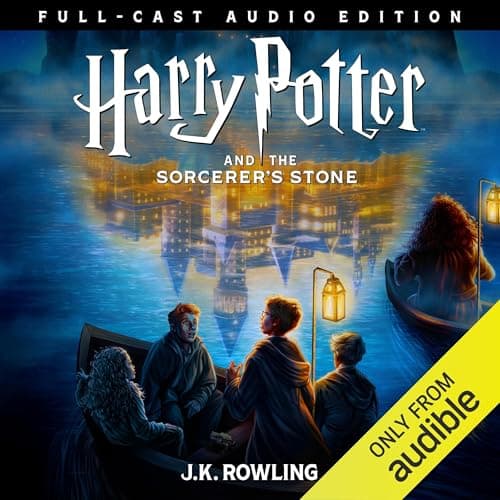

I was halfway through a solo road trip — the kind where you've been driving long enough that the podcast queue is empty and the radio is all static — when I fired this up. Within twenty minutes, I'd pulled into a rest stop parking lot because I realized I was so locked into the Diagon Alley sequence that I'd missed my exit. That's the kind of audiobook this is. It doesn't want to be your background noise. It wants your full attention, and if you give it that, it gives back something extraordinary.
Let me get the practical question out of the way first: should you spend a credit on this if you already own the Stephen Fry or Jim Dale versions? If you listen to audiobooks primarily while multitasking — folding laundry, commuting, doing yard work — this probably isn't your version. The sound design is so rich and layered that treating it as ambient audio means you'll miss half of what makes it special. But if you're the type who puts on headphones and gives a story your undivided attention, or if you want something the whole family can sit down with like a radio play, this earns every penny.
Cush Jumbo's narration anchors the whole production. She reads Rowling's prose the way a favorite aunt tells a bedtime story — unhurried, clear, with enough dramatic weight to keep you leaning in without ever tipping into melodrama. The beauty of the full-cast format is that she doesn't have to carry the dialogue. She sets the table, and then the actors walk through the door.
Hugh Laurie as Dumbledore is the casting choice I keep coming back to. Forget the booming wizard voice. Laurie gives us something softer — a headmaster who sounds perpetually amused by a joke only he understands, but underneath that wry twinkle there's a quiet sadness. His speech after the Sorting Ceremony landed differently than I expected. There's a gentleness in his delivery that made me understand, maybe for the first time in audio form, why students at Hogwarts feel safe around this man. It's not power. It's kindness.
Riz Ahmed's Snape will be the most debated performance, and that's exactly why it works. If you're expecting Alan Rickman's iconic drawl, you'll spend the first chapter fighting it. Ahmed goes younger, more restrained — a man holding himself under iron control rather than dripping with theatrical menace. I'll be honest: it took me a chapter to stop comparing. But by the midpoint, I was completely sold. There's real humanity buried in his delivery, a sense that Snape's cruelty costs him something. Whether this fresh take lands for you will depend on how tightly you grip the film versions.
Michelle Gomez brings her natural Scottish lilt to McGonagall with a precision that feels almost surgical. Every line has a snap to it, but genuine affection lives underneath the sharpness. Mark Addy's Hagrid is exactly the big-hearted, bumbling warmth the character needs — he sounds like a man who'd cry over a dragon egg. And Matthew Macfadyen understood the Voldemort assignment completely. His Dark Lord is quiet, cold, aristocratic. No scenery-chewing. Just intimate menace delivered at a near-whisper, which turns out to be far more unsettling than shouting.
Frankie Treadaway, Max Lester, and Arabella Stanton as the trio bring a natural energy to Harry, Ron, and Hermione that makes the dialogue feel spontaneous. They sound like actual kids, not adults performing childhood.
Now, the production. This is where headphones go from recommended to required. The Dolby Atmos design turns Hogwarts into a physical space. During Diagon Alley, shoppers move around you, doors open at different distances. The Great Hall feasts come with clattering cutlery and the murmur of hundreds of students. The Quidditch scenes are genuinely thrilling — the Golden Snitch whips past your ears with a sharp buzz that made me flinch. The troll scene is controlled chaos: stone crumbling, water splashing, grunts echoing off bathroom tiles. During Quidditch practice, there's a bone-snap so crisp and sudden I winced.
But the sound design occasionally gets ambitious to a fault. A few busy scenes mix the environmental audio a touch too high, and the effects compete with the narration rather than supporting it. It's not frequent enough to ruin anything, but it's worth sampling before you commit if you're sensitive to that kind of thing.
One more practical note: this edition uses UK phrasing rather than the American adaptations some of us grew up with. If "Philosopher's Stone" and British terminology catch you off guard, just know it's coming.
I had a similar full-attention experience with Babel — another audiobook that builds such a dense, layered world that the moment your mind wanders, you lose the thread. The difference is that Babel demands focus because of its intellectual density, while this one demands it because the production is so spatially immersive. Both reward dedicated listening. Neither works well as background.
The original musical score deserves mention — it's not borrowed from the films, and it underscores emotional beats without overwhelming them. During Dumbledore's quieter moments, the music pulls back to almost nothing. During the climactic confrontation, it swells just enough to raise your pulse.
At 8 hours and 41 minutes, this flies by. The pacing never drags, transitions between narrator and cast feel natural, and the production quality holds across over 200 voice actors. It lands somewhere between a traditional audiobook and a radio drama — theatre for your ears.
Who should listen: Families looking for a shared listening experience, Harry Potter fans ready for a genuinely new take, and anyone who treats audiobooks as an eyes-closed, headphones-on event. Who should skip: If your audiobook time is the commute or the treadmill and you need something that works on partial attention, stick with the Fry or Dale narrations — both are great. This one just plays a different game entirely.