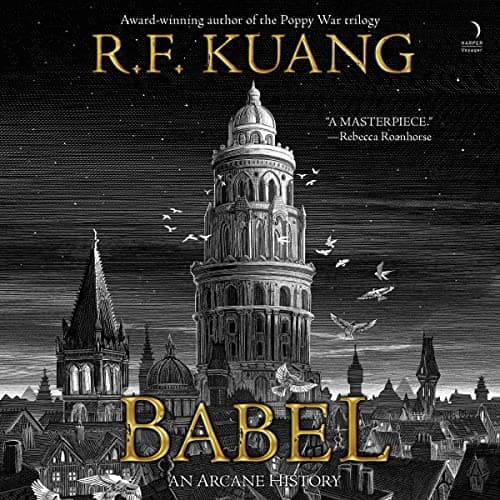

R.F. Kuang wrote a book about language and then weaponized it against you. Babel is a 21-hour academic fantasy set in 1830s Oxford that functions simultaneously as a love letter to etymology and a furious indictment of empire. If that sounds like it shouldn't work, you're not wrong to be skeptical — and yet it absolutely does.
Bottom Line: A slow-burn academic fantasy with a genuinely original magic system and dual narration that elevates the source material. Demanding but worth it if you want your fantasy to hit you in the brain and the gut simultaneously. Skip if you need action beats every thirty minutes or if 21 hours of linguistic theory and colonial critique sounds like homework.
Robin Swift is a Chinese orphan plucked from Canton by a British professor who sees him not as a child to save but as a linguistic resource to exploit. Raised in London and trained in Latin, Greek, Mandarin, and more, Robin eventually enters the Royal Institute of Translation — Babel — where silver bars powered by the untranslatable gaps between languages fuel Britain's magical and colonial dominance. It's the kind of magic system that makes you stop mid-listen and think, "Wait, that's genuinely brilliant." Translation as power. The meaning lost between languages as literal fuel for empire. Kuang isn't just being clever here; she's constructed an entire fantastical architecture around the real ways language has been used to dominate.
The audiobook production is a two-narrator affair, and the split works beautifully. Chris Lew Kum Hoi handles the main narrative and character voices with remarkable range — we're talking close to a dozen languages threaded through the text, and he navigates them with a facility that makes you forget you're listening to one person. His emotional delivery during Robin's increasingly painful moral reckonings genuinely landed. Billie Fulford-Brown narrates the footnotes, and here's where the audiobook format actually enhances the source material. Kuang's footnotes are sardonic, scholarly, and occasionally devastating, and Fulford-Brown delivers them with the precise dry wit of an Oxford don who's had it with the establishment. In print, you might skim footnotes. In audio, they become their own performance, and they're often the sharpest moments in the book.
Now, the pacing. This is where some listeners will hit a wall. Babel is not a plot-driven thriller dressed up in fantasy clothing. It's a slow, deliberate build through Robin's years at Oxford — his friendships with Ramy, Victoire, and Letty; his growing awareness of what Babel really serves; his agonizing position between two worlds that both want to use him. There are long stretches of academic life, linguistic theory, and philosophical debate about whether institutions can be reformed from within or must be torn down. If you need action beats every thirty minutes, this will test your patience. There were moments during my listen where I felt the middle section drag, particularly during some of the more extended classroom sequences. But Kuang earns that slow burn. When the story finally erupts into its violent conclusion, the emotional weight wouldn't hit nearly as hard without those quiet hours of watching Robin try to believe in a system that was never designed to include him.
What sets Babel apart from most academic fantasy is that Kuang refuses to let Oxford be cozy. She loves the architecture and the libraries and the thrill of intellectual discovery — you can feel that affection — but she never lets you forget who built those libraries and at whose expense. Robin's position as a Chinese student in 1830s England means every kindness comes with a cost, every friendship is shadowed by the question of who really belongs. The parallels to the Opium Wars aren't subtext; they're the text. Kuang has a PhD from Yale in Chinese history, and it shows in every line.
The magic system deserves special mention because it's the rare fantasy concept that's genuinely original. Silver bars inscribed with word pairs from different languages activate when the gap in meaning between translations is large enough. This means speakers of colonized languages are the most valuable translators — their mother tongues are the furthest from English — which creates a sickening feedback loop where empire literally requires the people it subjugates. It's the kind of idea that makes you set down your headphones and stare at a wall for a minute.
Compared to Kuang's Poppy War trilogy, Babel feels more controlled and more focused. The rage is still there, but it's channeled through a tighter lens. Where The Poppy War sometimes felt like it was sprinting through its influences, Babel takes its time and trusts you to sit with discomfort. That willingness to slow down and let moral weight accumulate rather than rush past it reminded me of what David Malouf does in Ransom — a quieter book, but one that similarly trusts the reader to stay with an uncomfortable reckoning rather than offering easy release.
This is a demanding listen. It requires your full attention — between the multilingual passages, the footnotes, and the layered arguments about colonialism and complicity, this isn't one to throw on while doing dishes. But if you give it the focus it asks for, you'll get an audiobook that's intellectually ferocious and emotionally bruising in equal measure. The dual narration elevates an already ambitious novel into something that genuinely benefits from the audio format. Kuang built a cathedral of a book, and Lew Kum Hoi and Fulford-Brown gave it exactly the vocal architecture it deserved.