
"War is peace. Freedom is slavery. Ignorance is strength."
I was lying on my couch at midnight on a Tuesday - Kevin was already asleep, I'd just closed a PR that took me three days to debug, and I figured hey, 4 hours, I can knock this out before my alarm goes off. Spoiler: I did. And then I lay there staring at the ceiling for another hour thinking about surveillance states and the architecture of totalitarian information systems.
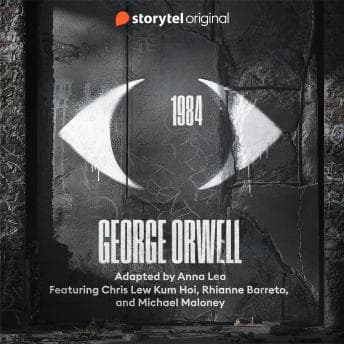
Look, you don't need me to tell you 1984 is important. You've probably read it. I read it in high school and again in college. But this isn't the standard audiobook. I keep a running list of re-reads that actually justify the second pass, and Life We Bury earned its spot on that list the same way - the story you thought you knew lands completely differently when the production pulls you back in. This is the Anna Lea "immersive re-telling" version, and that distinction matters - it's basically a radio drama wearing an audiobook's clothes.
This Isn't Your AP English 1984
TL;DR: Worth your commute, with caveats.
So here's the deal. Three narrators - Chris Lew Kum Hoi, Michael Maloney, and Rhianne Barreto - split the duties across Winston, O'Brien, Julia, and the broader narration. There are sound effects. There's ambient audio. The telescreen crackle is genuinely unsettling in a way that text on a page never quite landed for me. When the Two Minutes Hate kicks in, the production design puts you inside that crowd, and on noise-canceling headphones at midnight? My heart rate went up. No joke.
Maloney's O'Brien has this measured, almost gentle authority that makes Room 101 hit different. He sounds like a senior engineer calmly explaining why your architecture is wrong and you should feel bad about it - except the architecture is your entire belief system and the feeling bad part involves rats. Barreto's Julia is young and sharp and a little reckless, which tracks perfectly with the character. She doesn't sound like a love interest; she sounds like someone who's been running her own personal rebellion since before Winston even thought to question anything.
But Kum Hoi as Winston - this is where I'm conflicted. His delivery is subdued, almost flat in places, which I think is an intentional choice. Winston is beaten down. He's exhausted. He's a cog in a machine that's grinding him to dust. The flatness works thematically. But at 6AM on the Caltrain? There were moments in the first hour where his monotone blended into the ambient production sounds and I lost the thread. Had to rewind twice. At 1.5x, some of the sound design gets a little crunchy too - the overlapping audio layers don't compress well at speed.
Distributed Surveillance as a Service
Here's what hit me this time that didn't hit me at 17: Orwell basically described a distributed monitoring system with no single point of failure. The telescreens, the children spying on parents, the Thought Police, the self-censorship - it's redundant surveillance with multiple fallback layers. As someone who builds distributed systems for a living, the engineering of Oceania's control architecture is... horrifyingly elegant? The Party built a panopticon where the watched become the watchers. There's no primary node to take down. The system is the people.
And Winston's diary - his act of writing in a physical notebook where there are no backups, no version control, no audit trail - is basically an air-gapped system. His only hope of freedom is going fully offline. That broke my brain a little.
At 4 hours, this version is significantly shorter than the standard unabridged (which clocks around 11-12 hours). So yes, this is abridged/adapted. They've cut Goldstein's book-within-a-book way down, and some of the Newspeak appendix material is gone. If you want the complete Orwell experience, this isn't it. But if you want something that feels like 1984 in a way that pure narration sometimes doesn't - the claustrophobia, the paranoia, the ambient dread - the production design does real work here.
Who Gets the Credit (And Who Doesn't)
Perfect for: A single commute or a restless evening. The production quality rewards good headphones. If you've never read 1984, honestly, go get the Stephen Fry or Andrew Wincott narration first for the full text. But if you already know the story and want to experience it differently, this is a genuinely interesting adaptation.
Skip for: Deep work background listening - the sound effects demand too much attention. Also skip if abridgment makes you twitchy. They cut material, and you'll feel it if you know the original well.
The ROI on this audiobook is tricky. It's short, it's adapted rather than complete, and the production ambition occasionally trips over itself. But that midnight listen genuinely unsettled me in a way the book hasn't since I first read it. The sound of the telescreen humming in Winston's apartment, always on, always maybe listening - I caught myself glancing at my phone on the coffee table afterward. Which I think means it worked.