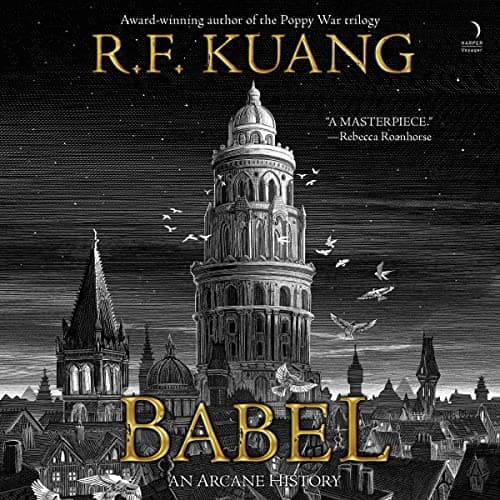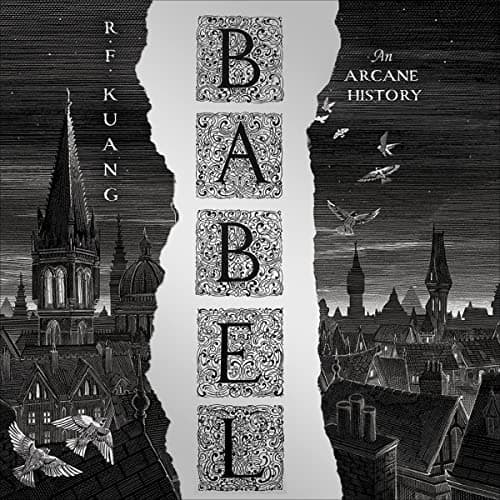

I was three hours into Babel during a solo road trip through the English countryside — the irony wasn't lost on me — when I realized I'd missed my exit twice because I was so absorbed in Robin Swift's arrival at Oxford. That's the kind of audiobook this is: one that hijacks your attention and refuses to give it back. I keep my full written breakdown of everything that makes this one work over at my Babel review page, which has ratings and more detail on the audio production specifically.
R.F. Kuang's alternate history imagines an 1830s Oxford where the Royal Institute of Translation, known as Babel, sits at the center of British imperial power. Silver bars inscribed with matched word pairs from different languages generate magic — actual, world-shaping magic — and translation scholars are the most valuable weapons the Empire possesses. Robin, orphaned in Canton and groomed by a mysterious English professor, arrives at Babel believing he's been given the opportunity of a lifetime. What unfolds is a slow, devastating education in what it costs to be useful to the people colonizing your homeland.
Let me be direct about the pacing, because it's the thing most likely to determine whether you love or abandon this audiobook. Kuang takes her time. The first half reads like a love letter to academia — the thrill of learning new languages, the camaraderie of late-night study sessions, the intoxicating feeling of belonging somewhere for the first time. If you've ever fallen in love with a university, those sections will hit hard. If you haven't, or if you need plot momentum to stay engaged, you might find yourself checking how many hours remain. At nearly twenty-two hours, there are stretches where the story breathes more than it moves.
But here's what Kuang does with all that setup: she makes you fall in love with the same things Robin does, so that when it all starts crumbling, the betrayal feels personal. The second half accelerates into questions about resistance, complicity, and whether meaningful rebellion is even possible from inside the institutions that benefit from your oppression. It's not subtle — Kuang isn't trying to be subtle — but it's earned through those patient early chapters.
Now, the narration. Chris Lew Kum Hoi handles the main text, and his performance is genuinely remarkable. The man moves between Mandarin, Cantonese, Latin, Greek, French, Arabic, and more with a fluency that feels almost absurd. For an audiobook that's fundamentally about the texture and power of different languages, having a narrator who can actually voice those differences is transformative. When Robin and his cohort debate the untranslatable gaps between words — the spaces where meaning lives and magic hides — Lew Kum Hoi makes you hear it rather than just understand it conceptually.
Billie Fulford-Brown handles the footnotes, and this is where the audio format actually improves on the print experience. Kuang's footnotes are frequent and occasionally lengthy, mixing real etymological history with the novel's fictional framework. In print, they can feel like interruptions. In audio, Fulford-Brown delivers them with a dryness that plays up their wit, turning what could be academic asides into something closer to a knowing commentary track. The two-narrator structure keeps you oriented — you always know whether you're in the story or in the margins.
Character differentiation is solid throughout. Robin's earnest intensity, Ramy's sharp anger, Victoire's quiet resolve, and Letty's increasingly uncomfortable privilege all come through distinctly. The emotional peaks — and there are several that genuinely wrecked me — land with full force precisely because the voice work has made these people feel real over many hours of listening.
I do want to flag the complexity factor. This is not a background listen. Between the multilingual passages, the footnotes, and the thematic density, you need to be present for this one. I tried listening while cooking once and had to rewind fifteen minutes. The book rewards your full attention and punishes anything less.
Some listeners have noted that Lew Kum Hoi isn't perfectly fluent in every language that appears in the text, and that's fair — it would take a team of specialists to nail every pronunciation. But the effort and range on display here is far beyond what most audiobooks even attempt, and it serves the story's central argument about language as power.
What makes Babel special isn't any single element — it's the way Kuang weaves together a magic system built on linguistics, a genuine love of scholarship, and a furious critique of empire into something that feels both fantastical and painfully real. The audiobook format amplifies this because you literally hear the languages colliding with each other. You hear the gaps between words that the characters spend their lives studying.
Who Should Listen (And Who Should Skip)
If you love language, history, and fantasy that's willing to get angry about colonialism, this is twenty-two hours well spent — especially if you have the patience for a slow academic first half that pays off enormously. Skip it if you need constant plot momentum or if you can't give an audiobook your undivided attention; the multilingual layers and frequent footnotes demand it.
Is it perfect? No. The pacing asks for patience, the politics are delivered with a heavy hand at times, and there are stretches in the middle where academic life dominates at the expense of forward momentum. But when Babel hits — and it hits repeatedly in its final third — it hits with the accumulated weight of everything that came before.