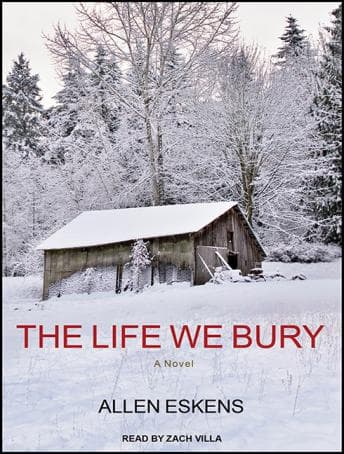

I was sitting at my dining room table at 10:30 PM, staring at a stack of sophomore essays that I swore I'd finish grading by Tuesday (it was Thursday), when I started The Life We Bury.
The irony wasn't lost on me. Here I was, tortured by teenagers trying to write five paragraphs on The Great Gatsby, listening to a story about a college kid, Joe Talbert, who has to interview a stranger for an English assignment.
(If one of my students turned in a biography of a convicted murderer dying of cancer, I'd probably have to call guidance. Or give them an A. Probably both.)
Usually, when I see "debut novel" and "mystery," I brace myself for clichés. But Allen Eskens—who I found out later was a criminal defense attorney, which explains a lot—wrote something that feels less like a cheap thriller and more like a character study that just happens to have a body count. And honestly? It kept me from throwing my red pen across the room.
Zach Villa Actually Sounds Like a College Kid
Let's talk about Zach Villa.
I'm going to be blunt: there is nothing more painful in the audiobook world than a 50-year-old narrator trying to sound like a 21-year-old college student. It usually sounds like that "How do you do, fellow kids?" meme.
Villa actually sounds young. He captures that specific blend of naivety and weariness that Joe carries. Joe isn't just a student; he's dealing with a chaotic mother and an autistic brother, and Villa puts that weight into the voice without making it melodramatic. Low-key. Grounded.
But the real magic trick? The way he switches to Carl Iverson. Carl is a dying Vietnam vet, a convicted murderer released to a nursing home to die. Villa drops his register, adds this gravelly, fluid-filled rasp that makes you want to clear your own throat. It's not a caricature—it feels like a performance. That same attention to character voice is what makes White Oleander so devastating—the narrator captures a teenager's perspective without ever sounding fake.
(My students think I'm obsessed with "voice" in literature. If they heard this, they might actually get what I'm talking about. Maybe.)
A Slow Burn That Actually Burns
I'll admit—the first hour? I was checking my watch.
It starts a little slow. Villa's narration is very deliberate. I almost bumped the speed to 1.25x (which goes against my religion, I know, "the author chose the pacing," blah blah blah). But I stuck with 1.0x, and I'm glad I did.
Once Joe starts peeling back the layers of Carl's conviction, the pacing clicks into place. The Minnesota setting feels cold—like, physically cold. Villa does a great job of making the atmosphere feel oppressive and freezing, which is perfect because I was listening to this while walking along Lake Michigan in November. The wind was whipping my face, Villa was describing the snowy roads, and I felt... immersed.
It's not an action movie. It's an unraveling.
The "English Teacher" Verdict
What hooked me wasn't the "did he do it?" question. It was the relationship between the boy and the old man. There's a scene where they discuss the Vietnam War, and the writing shifts from procedural to something much heavier. Eskens gets the trauma right. I felt that same weight in The Count of Monte Cristo—trauma handled with care, not spectacle. And Villa delivers those lines with a kind of quiet reverence that actually made me pause my walk.
There are moments where the plot relies on Joe doing things a college kid probably wouldn't do (playing detective a bit too effectively), but I bought it because I liked him. I was rooting for him.
The legal details? Sharp. You can tell Eskens knows his way around a courtroom. It doesn't feel like Law & Order fanfiction. It feels real.
Final Thoughts
If you want an explosion every five minutes, this isn't it. Go find a Jack Reacher book.
But if you want a story that feels like a really good, dark indie movie for your ears? This is it. It's messy, it's sad, and it's hopeful.
Who should listen: Anyone who loves character-driven mysteries, stories about unlikely connections, or audiobooks where the narrator actually sounds like the protagonist's age. Who should skip: If you need constant action or hate slow-burn openings, you'll get restless.
I finished it in two days. My students' papers are still ungraded. (Sorry, Principal Martinez. Blame Allen Eskens.)