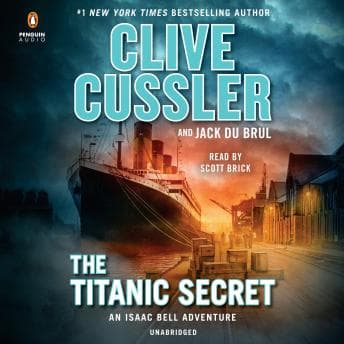

I'll admit something that might get my literature credentials revoked: I've been on a Clive Cussler kick lately. Started as a guilty pleasure between denser works, and now here I am, eleven hours into an Isaac Bell adventure, grading sophomore essays on The Great Gatsby while Scott Brick describes a 1911 mine disaster in Colorado. The cognitive dissonance is real.
Here's the thing about The Titanic Secret that nobody seems to want to say outright - the Titanic is barely in this book. I mean, it's there. It matters to the plot. But if you're coming in expecting some deep exploration of the disaster, expecting to feel the cold Atlantic water and hear the band playing, you're going to be disappointed. This is a byzanium story wearing a Titanic costume. And honestly? Once I stopped fighting that expectation, I enjoyed it more.
The Dual Timeline Dance
The structure here is interesting - Dirk Pitt in the present day, Isaac Bell in 1911, connected by a document and a mystery. It's a narrative device Cussler has used before, but there's something satisfying about watching these two timelines eventually crash into each other like, well, an iceberg and a ship. The Pitt sections feel like appetizers between the main course of Bell's investigation, which is where the real meat lives.
Bell's investigation into the Little Angel Mine deaths is classic detective work - the kind of methodical, boots-on-the-ground sleuthing that reminds me why I fell in love with historical fiction in the first place. There's a patience to how Bell works that modern thrillers often lack. That same methodical approach anchors Heart of Darkness, though Conrad takes it to much darker psychological territory. He interviews. He observes. He rides a lot of trains. (So many trains. If you have any affection for vintage rail travel, this book delivers.)
The byzanium element - this rare substance with extraordinary powers - is where the story gets a bit... contrived. I can hear my students groaning at the MacGuffin. But Cussler commits to it so fully that you either buy in or you don't. I bought in around hour four, somewhere between loading the dishwasher and realizing I'd been standing in my kitchen holding the same plate for ten minutes.
Scott Brick Carries the Weight
Let me be direct: Scott Brick is the reason this audiobook works. The man could narrate a phone book and make it sound like espionage. His pacing is impeccable - he understands that pause is punctuation, something I've been trying to teach teenagers for two decades with limited success.
What Brick does particularly well here is differentiate between the time periods. His modern-day Pitt sections have a different energy than the 1911 Bell sequences. It's subtle - a slight shift in rhythm, maybe a touch more formality in the period sections - but it helps your brain track where you are in the timeline without the audiobook having to announce it every five minutes.
I've listened to enough Cussler audiobooks now to recognize that Brick is doing heavy lifting. The prose itself isn't Hemingway. (This reminds me of what Hemingway said about economy of language - Cussler takes the opposite approach.) But Brick finds the momentum in every scene, even the exposition-heavy ones.
Where It Drags
At eleven hours, this story could have been tighter. There are sequences - particularly some of the vintage vehicle scenes - that feel like they exist because Cussler loved writing them rather than because the plot demanded them. I respect a writer who indulges his passions, but around hour seven, I was ready for the story to stop admiring the upholstery and get back to the mystery.
Some listeners have noted that this book lacks the usual Cussler wittiness. I think that's partly a Jack Du Brul influence - you can feel the difference in authorial voice between sections, and Du Brul tends toward straighter adventure. Neither approach is wrong, but the tonal shifts can be jarring if you're expecting consistent banter. Golden Lion handles multiple authors more smoothly, maintaining Wilbur Smith's signature energy throughout.
Who Should Listen (And Who Should Skip)
If you're a Cussler completist, you already know you're listening to this. If you're coming in fresh, this isn't where I'd start - it's the eleventh Isaac Bell novel, and while it stands alone, you'll miss some of the character history that makes Bell's choices land. Skip this one if you want actual Titanic drama or need action in the first hour. But if you appreciate slow-burn historical adventure and Scott Brick's narration? You'll find plenty to enjoy here.
For everyone else: this is solid historical adventure fiction. Not transcendent, not disappointing. The kind of audiobook that makes a long commute feel shorter and makes grading papers at 11 PM slightly less soul-crushing. Scott Brick's narration elevates adequate prose into genuinely entertaining listening.
Just don't expect a Titanic story. Expect a treasure hunt in period costume with a famous ship cameo. Adjust your expectations accordingly, and you'll have a good time.
My students would probably hate this. Too slow, too much setup, not enough explosions in the first hour. Which is exactly why I enjoyed it.