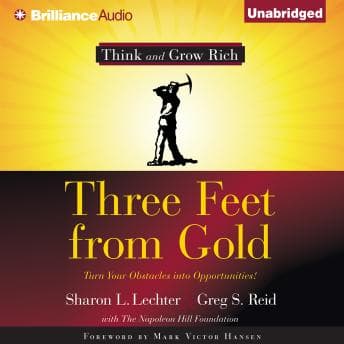

I was waiting for Jenny at her dentist appointment - one of those strip mall places where the magazines are from 2019 and the WiFi password is taped to a dying ficus - when I fired this up. Five and a half hours. Finally, a business book that respects your time. Or at least doesn't actively disrespect it.
Bottom line: Three Feet From Gold is a decent gateway drug into Napoleon Hill's principles, wrapped in a fictional story that's trying very hard to make you feel something. It mostly works. Mostly.
The Dry Cleaner's Son Reviews a Book About Not Quitting
Here's what got me. The central metaphor - a man who stops digging three feet from a gold vein - is literally the story of every small business owner I grew up around in Koreatown. My dad's dry cleaning business almost went under in 1997. He was, metaphorically, two feet from gold. He didn't quit. No one gave him a Personal Success Equation™. He just showed up at 5 AM the next day and pressed shirts. My parents never needed a framework to name what they were doing — they just did it, which is why books that try to codify that instinct always put me in a complicated headspace.
So when Reid and Lechter build their fictional framework around a struggling young entrepreneur named Greg who stumbles into mentorship from real-world business leaders, I'm watching with one eyebrow permanently raised. The structure is straightforward: Greg meets a powerful businessman named Don Green (who's actually the CEO of the Napoleon Hill Foundation - not fictional), and Don sends him on a cross-country journey interviewing successful people. Each interview unpacks a Hill principle. Persistence. Definiteness of purpose. The mastermind concept.
The problem with the first hour or so is that it reads more like a Wikipedia entry on Napoleon Hill than a story. Facts stacked on facts. I almost bailed. Glad I didn't - it picks up once Greg actually starts talking to people and the conversational energy kicks in. But that slow start is real. Skip to chapter 5. Thank me later. Or at least power through the setup knowing it gets better.
What My Parents Did Instinctively. Now It Has a TED Talk.
The Personal Success Equation - (P+T) x A x A + F = Success (Passion plus Talent, times Action, times Association, plus Faith) - is the kind of thing that sounds smart on a slide deck and means almost nothing until you see it applied. To the book's credit, each interview does try to ground these variables in real stories. The section on association - surrounding yourself with the right people - actually landed for me. I've seen this fail at three different companies where founders hired friends instead of talent and wondered why their Series A evaporated.
But here's my issue: the book can't decide if it's a parable or a textbook. One moment you're in Greg's emotional arc - losing his business, questioning everything - and the next you're getting a lecture on definiteness of purpose that could've been pulled from a LinkedIn carousel. The tonal whiplash isn't fatal, but it's noticeable. Jenny would say I'm being harsh. Jenny is right. The book's heart is in the right place.
The key takeaway is worth the listen. The other 4 hours? Not so much. The core message - that most people quit right before the breakthrough - is genuinely useful if you're in the trenches of building something. It's not revolutionary if you've already read Think and Grow Rich, but it's a more accessible entry point.
Dan John Miller Makes You Forget You're Being Lectured
Dan John Miller does something sneaky with this narration - he makes the didactic parts feel like a conversation over coffee rather than a TED talk. His delivery has this casual warmth where even the more formulaic interview sections feel like he's personally telling you about someone he met. When he shifts into Greg's internal doubt, there's a genuine vulnerability in his voice that elevates what could've been a cardboard protagonist. No vocal gymnastics, no dramatic pauses for effect. Just a guy telling you a story like he means it.
At 2.0x he still sounds natural, which is my personal litmus test for narrator quality. Some narrators turn into auctioneers at double speed. Miller just sounds... caffeinated.
Who Gets the Gold and Who Should Keep Walking
If you're early in your career or going through a rough patch with your business, this is a solid listen. It's motivational without being saccharine, and at under six hours it won't monopolize your week. If you've already consumed Napoleon Hill's work and a shelf of business books, you're going to recognize about 80% of the ideas here wearing slightly different clothes. And if the phrase "Personal Success Equation™" makes you want to throw your phone out the car window - fair. I get it.
But I keep coming back to that image of someone quitting three feet from gold. My dad didn't have a book to tell him to keep going. He just did. This book won't replace that kind of grit. But for someone who needs permission to keep digging? It might be the nudge.