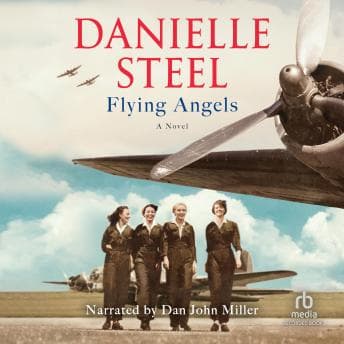

I was grading a stack of sophomore essays on The Great Gatsby - the ones where they all discover that green light symbolism like it's a personal revelation - when I realized I'd been listening to Flying Angels for three hours without pausing once. That never happens during grading. Usually I'm reaching for the pause button every ten minutes to scribble corrections. But Dan John Miller's subdued, steady narration had created this strange cocoon where World War II flight nurses and Nick Carraway's symbolism coexisted peacefully in my late-night kitchen.
Danielle Steel isn't Hemingway. Let's get that out of the way. But here's what twenty years of teaching has taught me: there's a difference between literary merit and narrative craft, and dismissing one because it lacks the other is intellectual snobbery I can no longer afford. My students would love this. I didn't hate it.
Six Women, One War, and Prose That Doesn't Get in Its Own Way
Steel gives us Audrey Parker, whose brother dies at Pearl Harbor, setting her on a path toward the Medical Air Evacuation Transport Squadron. She's joined by Lizzie (the best friend), Alex (the idealist), Louise (facing racial prejudice in a segregated military), Pru (the maternal leader), and Emma (the gritty one). If you're thinking these character sketches sound like archetypes - you're right. Steel isn't interested in subverting expectations. She's interested in honoring a historical reality that most Americans have never heard of.
And here's where my English teacher brain kicked in: these women actually existed. Not these specific characters, but the WASP pilots, the flight nurses, the women who flew into combat zones without rank, without adequate pay, without recognition. Steel's research shows. The details about altitude sickness, about treating wounded soldiers mid-flight, about the sheer physical danger of these missions - it reads like someone who actually talked to historians.
The prose itself? Workmanlike. Efficient. Steel writes like someone who has published 190 novels and knows exactly how to move a story forward. There's no Faulknerian sentence you'll want to pause and savor. But there's also no pretension. She chose these words to tell a story, not to impress you with her vocabulary. At seven hours and eighteen minutes, it's the literary equivalent of a satisfying meal that doesn't leave you stuffed.
Miller's Gift: Knowing When to Step Back
Dan John Miller has won Audies. He's been named Best Voice by AudioFile. The man knows what he's doing. And what he does here is fascinating - he doesn't perform, he presents. His narration is subdued in a way that initially surprised me. I expected more vocal fireworks for six distinct female characters.
But here's what I realized around hour four: Miller understands that this isn't his story to dominate. His pacing is deliberate, his phrasing careful. He captures the emotional heart of the novel without ever overshadowing the women he's giving voice to. It's a male narrator telling women's stories, and he navigates that with something approaching humility.
Does he deliver distinct voices for every character? Honestly, the differences are subtle. Louise doesn't get a Southern accent that might veer into caricature. Pru doesn't sound dramatically different from Emma. But the emotional register shifts - you can hear the weariness in the late-war chapters, the hope in the early ones. Miller trusts the text to do the heavy lifting, and for Steel's straightforward prose, that's the right call.
The Hemingway Problem (Or: Why This Isn't What I Usually Recommend)
Hemingway wrote about courage as grace under pressure. These flight nurses had it. Steel captures it. But Hemingway would have written this book in 40,000 words with subtext you'd need a graduate seminar to unpack. Steel writes it with subtext you can absorb while grading papers.
Is that a criticism? I genuinely don't know anymore.
My wife Denise would love this. She reads Steel on the beach every summer while I pretend Middlemarch is beach reading. (It isn't. I know it isn't.) There's room for both. There's room for books that challenge you and books that comfort you while teaching you something you didn't know.
I didn't know about flight nurses before this. Now I do. That's worth something.
Who Gets an A, Who Gets a Pass
If you want literary fiction that rewards close reading and multiple listens - this isn't it. Skip it. Go listen to The English Patient or something.
But if you want accessible historical fiction with heart, a narrator who respects his material, and a story about women whose heroism has been largely forgotten? This is worth your seven hours. It's the kind of book my mom would stay awake for. (Sorry, Faulkner.)
Perfect for: long walks, housework, anyone who loved The Nightingale but wants something less devastating. That same accessible-but-meaningful vibe shows up in Nine Perfect Strangers, though with less historical weight. Less perfect for: literary snobs, people who need complex character arcs, anyone allergic to earnestness.
Worth Pausing the Faculty Meeting For?
Almost. Not quite. But I finished it, which is more than I can say for Principal Martinez's budget presentation.