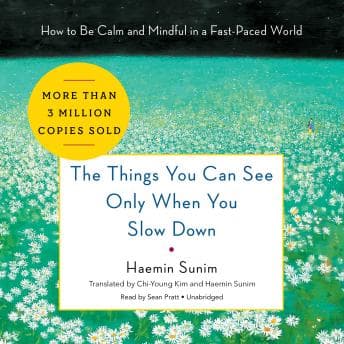

Look, I have a problem. I listened to a book literally called Things You Can See Only When You Slow Down at 1.5x speed. On a packed 6:47 AM Caltrain. While triaging Slack notifications from an overnight deploy. The irony isn't lost on me. Haemin Sunim would probably have something gentle and wise to say about that, and honestly, he kind of does.
But here's my complaint: at 2 hours and 52 minutes, this book is shorter than some production incidents I've debugged. At my usual 1.5x, I blew through it in a single round-trip commute with time to spare. And for a book about slowing down, the structure actually moves fast — jumping between topics like relationships, love, ambition, and spirituality in these short, aphoristic bursts that feel less like chapters and more like a curated Instagram feed of Buddhist wisdom. Which... might be the point? But it also means you barely settle into one idea before it pivots to the next.
The Anti-Optimization Book for the Optimization-Obsessed
I spend my days optimizing distributed systems and my commute optimizing audiobook consumption per hour. So when Haemin Sunim opens with "Is it the world that's busy, or is it my mind?" — yeah, that landed. The book is structured around eight themes, and each one reads like a collection of short meditations rather than a sustained argument. Think less Atomic Habits (build a system!) and more fortune cookies written by someone who actually earned the wisdom.
The best bits are the ones about self-compassion and forgiveness — Sunim has this way of reframing anxieties that's disarmingly simple without being simplistic. There's a passage about how when you're angry at someone, your mind is actually suffering more than theirs, and the way Sean Pratt delivers it with this measured, unhurried cadence... it genuinely made me put down my phone for a second. On the Caltrain. At rush hour. That's saying something. That passage on anger made me think of Never Get Angry Again, which digs into the mechanics of why we lose our cool—though it's more tactical than meditative.
But the transitions between topics can feel abrupt — like context-switching between three different Jira boards with no handoff notes. You'll be sitting with something about loneliness, and then suddenly you're in a section about career ambition, with these extended pauses between segments that at first I thought were audio glitches. They're not. They're intentional breathing room. Which is a cool concept that my 1.5x-speed brain initially rejected before grudgingly admitting it worked. My engineer's compulsion to dissect systems also had me reaching for Applied Minds, narrated by Pratt with the same steady hand—it's like a manual for why I can't stop optimizing, even when I'm trying to be present.
Sean Pratt Did Not Need to Go This Soft and It Works
Sean Pratt is no Ray Porter (nobody is, fight me), but he's doing something interesting here. His narration is almost aggressively calm — like the vocal equivalent of someone placing a warm cup of tea in your hands and refusing to let you check your email. For a book of this nature, that works. He doesn't try to perform the text or inject drama. He reads Sunim's words like he's sitting across from you in a quiet room, and every sentence gets this deliberate, even pacing that forces you to actually absorb it.
The downside? If you're already drowsy — say, 6 AM on a Monday after weekend on-call — that same soothing quality can tip you right into sleep. I caught myself drifting during a section on spirituality and had to rewind about four minutes. Not Pratt's fault, really. The man was hired to sound like a meditation app and he delivered. That calm voice also got me through One-Minute Workout, a book I never expected to enjoy—but his pacing turned it into something almost serene, like exercise science via guided meditation.
Who This Is (and Isn't) For
Perfect for: bedtime wind-down, a rough mental health day, background listening during a low-key coding session. If you've been grinding through 15-hour sci-fi epics and need a palate cleanser, this is that.
Skip for: anyone expecting actionable frameworks or structured self-help. This isn't a system. There are no steps. It's closer to poetry than productivity. If you need your self-help books to come with a spreadsheet template, you'll be frustrated.
Also skip if you want ROI per credit dollar — at under 3 hours, this is the kind of thing you stream through your library app or Spotify, not burn an Audible credit on. I did the math (because of course I did): that's roughly $5 per hour of content at credit pricing. For comparison, Project Hail Mary clocks in at about $0.90/hour. I know, I know — Sunim would tell me comparing the value of inner peace to cost-per-hour is exactly the kind of thinking his book is trying to fix.
He's probably right.
The Bug Report
TL;DR: Worth your commute. Barely — because it's shorter than your commute. But it might be the one audiobook this year that actually makes you slow down for five minutes, and if you're anything like me, you probably need that more than another 40-hour space opera. Probably. (I'm still going to listen to the space opera though.)