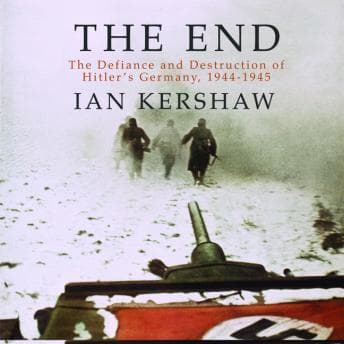

The Berlin Philharmonic performed on April 12, 1945. Three weeks before Hitler ate his pistol, with Soviet artillery close enough to rattle the concert hall windows, musicians played Beethoven's Violin Concerto and — if you can believe it — Bruckner's Romantic Symphony. People actually showed up. Dressed nicely. Kershaw drops this detail like a grenade into your lap and then moves on, which is exactly the right instinct because the whole book is full of moments that stop you cold.
I was up past midnight with this one, going through client risk assessments at my desk while Ranger snored underneath it, and I had to pause the audio more than once just to sit with what I'd heard.
The Question Nobody Else Has Really Asked
Let me cut to the chase — there are roughly ten thousand WWII books about why Germany lost. Kershaw asks something different: why didn't they quit? Historically, this is bizarre. States facing certain military defeat almost always negotiate, capitulate, or experience internal revolution. Germany in 1918 did exactly that. But from July 1944 to May 1945, with the Wehrmacht bleeding out on two fronts and cities getting turned to rubble nightly, the Third Reich just... kept going. Kept fighting. Kept killing.
As someone who spent 25 years in uniform, this question hit me hard. I've seen what happens when command structures break down, when morale collapses, when soldiers realize the mission is finished. It happens fast. The fact that it didn't happen in Germany — not in any meaningful way — until there was literally no Germany left to fight for? That's not just a historical curiosity. That's a case study in how ideology, terror, and institutional loyalty can override every rational survival instinct a human being has.
Kershaw structures the book chronologically, starting with the July 20 bomb plot, and he argues convincingly that the plot's failure actually tightened the regime's grip. It eliminated the one group — military aristocrats, old-school Prussian officers — who had the institutional power to challenge Hitler, and gave the regime an excuse to purge anyone with a shred of independent thought. After July 20, the SS essentially colonized the Wehrmacht's command structure. The author clearly did their homework, and given that this is the man who wrote the definitive Hitler biography, that shouldn't surprise anyone, but the depth of primary source material here is staggering.
Obedience All the Way Down
What makes this book genuinely disturbing — and valuable — is Kershaw's analysis of how the system perpetuated itself. It wasn't just Hitler being delusional at the top. It was Gauleiters enforcing total war in their regions because their power derived entirely from the regime. It was Wehrmacht generals who knew the war was lost but kept sending men into hopeless positions because the alternative was a firing squad or piano wire. It was ordinary Germans who kept going to work, kept putting out fires after bombing raids, kept maintaining some version of normal life because — what else were they going to do?
I've seen this scenario play out in real life, obviously at a much smaller scale. In Iraq, you'd encounter organizations that kept functioning well past the point of strategic collapse because the local power structure incentivized compliance and brutally punished deviation. Kershaw's concept of the "negative bond" between Hitler and his leadership — they had no future without him, so their fates were welded together — is one of the most useful frameworks I've encountered for understanding how authoritarian systems resist collapse. I actually flagged that section to share with a client.
He's also unflinching about the regime's final months of persecution. Death marches. Summary executions of German civilians who displayed white flags. The continued deportation and murder of Jews and forced laborers even as the logistics of killing competed with the logistics of fighting. Grim material, and Kershaw doesn't look away.
Sean Pratt and 18 Hours of Discipline
Sean Pratt handles 18 and a half hours of this without ever sounding like he's phoning it in. His pacing matches the material — measured, authoritative, not dramatic. This isn't a book that needs theatrical voices or emotional crescendos. It needs clarity and gravity, and Pratt delivers both. His pronunciation of German names and places sounds confident and consistent, which matters when you're cycling through dozens of Wehrmacht officers, SS officials, and Gauleiters whose names would trip up a lesser narrator. I bumped it to 1.25x around hour five and it settled into a perfect rhythm — the default speed is just a touch deliberate for my taste, but that's a me problem, not a Pratt problem.
I’ve heard him handle entirely different material with the same steady hand, like Less Doing, More Living, where he turns productivity advice into a mission briefing you actually want to follow.Who Gets This Assignment
Worth your time? Here's the debrief. If you're a WWII reader already familiar with the broad strokes — D-Day, Bulge, fall of Berlin — and you want to understand the why underneath the what, this is essential. If you're in military leadership, security studies, or anything adjacent, the structural analysis alone justifies the 18-hour commitment.
Skip it if you're looking for a battlefield narrative or personal war stories. This isn't Band of Brothers. It's more like an autopsy of a political system performed while the patient was still technically alive. Kershaw spends more time in Reich Chancellery offices and Gauleiter headquarters than on front lines, and that's deliberate.
If you're up for another dense but rewarding history that isn't about the battlefield, One Summer, America, 1927 takes you inside 1920s America with the same unflinching eye.One warning: this is dense. Not boring — Kershaw's skilled enough to keep the narrative moving — but dense. Don't put this on while mowing the lawn. You need to be locked in or you'll lose the thread of which regional commander is doing what in which collapsing sector.
Ranger slept through most of it but perked up during the sections on the Ardennes offensive. Smart dog.
Mission accomplished, Kershaw. Damn near perfect mission, actually.





![Steve Jobs [unabridged audiobook] audiobook cover](/_next/image?url=https%3A%2F%2Fcovers.audiobooks.com%2Fimages%2Fcovers%2Ffull%2F9788499923406.jpg&w=1920&q=75)