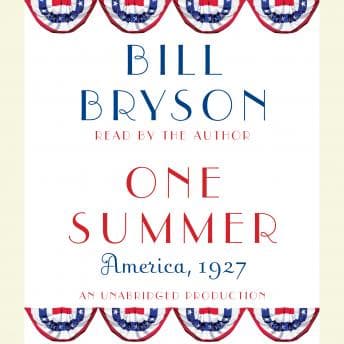

Look, I have a complaint. Bill Bryson made me care deeply about flagpole sitting. Flagpole sitting! A man named Shipwreck Kelly perched on a pole in Newark for twelve days, and somehow Bryson turned this into genuinely compelling content. I was on my morning jog through Cambridge, genuinely invested in whether this guy would fall off his flagpole. My therapist would have thoughts about this.
This is seventeen hours of 1927, and I mean ALL of 1927. Lindbergh's flight, Babe Ruth's home run chase, a murder trial involving a corset salesman (yes, really), the Mississippi floods, Al Capone, the birth of talking pictures, and a secret meeting of bankers that basically set up the Great Depression. It's a lot. It's almost too much. But here's the thing—Bryson understands something fundamental about human psychology: we don't experience history as neat chapters. We experience it as chaos happening simultaneously.
A Case Study in American Obsession
What makes this book fascinating from a psychological perspective is how Bryson captures the collective mania of the era. The Lindbergh worship? Classic parasocial relationship formation on a mass scale. 1927 America basically invented modern celebrity culture. The attachment patterns driving this kind of obsession get a fascinating deep-dive in Wired for Love, though applied to romantic relationships rather than aviators. Lindbergh lands in Paris and suddenly everyone needs to name their baby after him, buy Lindbergh merchandise, claim they met him once. The protagonist—and yes, America itself is the protagonist here—exhibits classic displacement behavior. A country that had just survived a war and was hurtling toward economic disaster chose instead to fixate on a skinny pilot and a baseball player.
The Ruth Snyder murder case is where I found myself asking: why does this story really matter? On the surface, it's tabloid garbage—a bored housewife and her lover kill her husband. But Bryson uses it to illuminate something darker about American appetites. The public wanted blood, wanted spectacle, wanted to watch a woman fry in the electric chair. And the newspapers gave them exactly that, including an illegally snapped photo of her execution. Psychologically, this doesn't track with the wholesome Lindbergh worship happening simultaneously. Except—it absolutely does. Both are about consuming other people's lives as entertainment.
Bryson in Your Ears
Bryson narrating his own work is genuinely delightful. He's got this warm, slightly amused delivery—like your favorite professor who actually wants you to understand the material. His cadence is perfect for long commutes or those elaborate cooking sessions I do alone (don't feel sorry for me, I prefer it). There's a dry wit in his delivery that matches the prose, and he knows exactly when to pause for comedic effect.
The weakness—and it's real—is that the book jumps around. A lot. You'll be deep in Lindbergh's preparation, then suddenly you're with Babe Ruth, then you're watching the Mississippi River destroy everything in its path. I occasionally lost track of where we were in the timeline, especially during my jogs when I was also trying not to get hit by Cambridge drivers who apparently never learned what crosswalks mean. But honestly? The jumping around mirrors how people actually experienced that summer. Nobody was following one story. They were reading newspapers full of everything at once.
The Uncomfortable Parts Nobody Mentions
I need to flag something: this book doesn't shy away from the racism of the era, including the Klan's influence and the horrific treatment of Black Americans during the Mississippi floods. Bryson handles this with appropriate gravity, but some listeners might find it jarring against the lighter material about flagpole sitters and baseball records. I actually appreciated this. You can't understand 1927 America without understanding that it was simultaneously obsessed with silly spectacles AND actively oppressing huge portions of its population. The cognitive dissonance was the point.
My Prescription
For history buffs and Bryson fans, this is a must-listen. Seventeen hours sounds daunting, but it flew by. If you need tight, linear narratives, sample first—the structure is intentionally chaotic, and that's not for everyone. Skip if you want deep analysis of any single event; Bryson's doing breadth, not depth.
What makes this audiobook work is Bryson's fundamental understanding of human nature. He knows we're ridiculous creatures who will worship a pilot one minute and demand executions the next. He knows our collective psychology is messy and contradictory and often embarrassing. And he presents it all with such warmth that you end up loving 1927 America despite—or because of—its absurdity.
My one complaint? I now know way too much about flagpole sitting. This information will never leave my brain. Thanks, Bill.