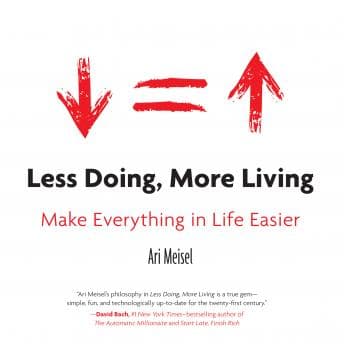

I was halfway through prepping a ridiculously ambitious biryani—the kind that takes three hours and dirties every pot I own—when I realized I'd been listening to Ari Meisel tell me how to simplify my life while actively making mine more complicated. The irony wasn't lost on me.
But here's the thing. By the time the rice was layered and the dum was on, I'd already reorganized my entire approach to my research assistant requests. So maybe Meisel's onto something.
The Psychology of Getting Out of Your Own Way
What makes this book work—and I say this as someone who's read approximately seventeen productivity books that all blur together—is that Meisel doesn't pretend you're broken. The research actually shows that most productivity advice fails because it assumes the problem is motivation. It's not. The problem is cognitive load. Wired for Love explores similar neuroscience territory, though it applies the brain science to relationships instead of productivity.
Meisel gets this. His "external brain" concept—offloading lower-order thinking to apps and cloud systems so your actual brain can do the interesting work—is essentially applied cognitive psychology dressed up in tech-bro clothing. And I mean that as a compliment. He's describing what psychologists call "cognitive offloading," but he's making it actionable instead of theoretical.
The three fundamentals he outlines (fitness, sleep, nutrition) aren't revolutionary. But his technological approaches to tracking and optimizing them? Actually useful. He's not telling you to meditate for an hour. He's telling you to automate the decision-making that drains you before you even get to the hard stuff.
Sean Pratt Keeps It Moving
At 2 hours and 26 minutes, this is essentially a long podcast episode. Sean Pratt narrates it like one—clear, punchy, no dramatic pauses where they don't belong. He's not trying to make you cry or gasp. He's trying to deliver information efficiently, which is... kind of perfect for a book about efficiency.
No music, no sound effects, just straightforward delivery. Why does this work when so many business audiobooks feel like being lectured at? I think it's because Pratt doesn't oversell. He trusts the material to land without vocal gymnastics. The concepts are punchy enough on their own.
What Actually Stuck With Me
One listener mentioned implementing Meisel's "public days" concept—designating specific days for meetings and external obligations—and calling it a game changer. That's the kind of specific, immediately applicable advice that separates useful productivity content from the aspirational nonsense that makes you feel good for three days before you forget everything.
The paper-free life stuff is a bit dated (this was published in 2014, and we're all mostly there now anyway), but the underlying principle—eliminate friction wherever possible—holds up. Psychologically, this tracks. Decision fatigue is real. Every small choice you don't have to make is energy preserved for choices that matter. The automation philosophy here actually mirrors what Automatic Millionaire does with finances—set it up once, let systems handle the rest.
My therapist would have thoughts about the implicit assumption that optimizing everything is desirable. There's something slightly manic about the premise that we should automate and outsource every possible task. But Meisel's framing—that the goal is more living, not more doing—saves it from feeling pathological. He's not telling you to work more. He's telling you to work smarter so you can stop working.
The Limitations (Because Nothing's Perfect)
This is a 2014 book, and some of the specific app recommendations are probably obsolete. The principles translate, but you'll need to find your own tools. Also, if you're already a productivity nerd who's read Getting Things Done and Atomic Habits and everything else, you might not find much new here. Meisel is synthesizing existing ideas more than inventing new ones.
And look—the Wharton grad, Ironman athlete, TEDx speaker bio? It's a lot. Not everyone has the resources to outsource their dry cleaning and hire virtual assistants. Some of the advice assumes a certain income bracket that Meisel never explicitly acknowledges.
Who This Works For (And Who Should Skip)
If you're drowning in tasks and genuinely don't know where to start simplifying, this is a solid primer. Short enough to finish in an afternoon, practical enough to implement immediately. Good for driving, good for cooking elaborate meals while questioning your life choices. But if you're already an optimization person with systems in place, you'll probably spend the whole time thinking "I already do that." Skip it.
Case Closed
This is a fascinating case study in how to write a productivity book that doesn't make you feel terrible about yourself. Meisel's not shaming you for being inefficient. He's just... offering tools. Take what works, leave what doesn't. My biryani turned out great, by the way. And I've already automated three things that were annoying me. So. Evidence-based results, I suppose.