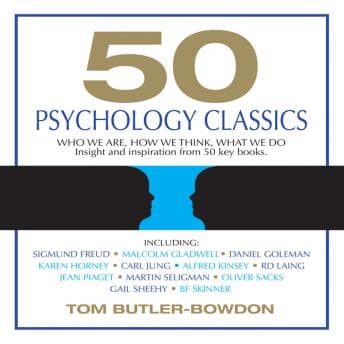

I was standing in my kitchen, aggressively chopping onions for a vindaloo—(cooking is my meditation, don't analyze it)—while listening to 50 Psychology Classics. My mother would probably say I should be listening to something "relaxing," but honestly? Hearing a breakdown of human behavior while crying over onions feels... appropriate.
Here's the thing. As a behavioral psychologist, I usually have a visceral, allergic reaction to summaries. My instinct is to scream, "Read the primary source! Context matters!" at my poor undergrads. But I needed a refresher for a lecture on narrative identity, and I didn't have time to dig through the dusty stacks in my office. So, I pressed play on this.
And—don't tell my dissertation committee—I actually kind of loved it.
The "Cheat Sheet" Vibe
Let's be real for a second. Nobody has time to read all of these. I mean, sure, I have Freud and Jung on my shelves (mostly to look smart on Zoom calls), but have I read every word of The Interpretation of Dreams since grad school? Absolutely not.
Tom Butler-Bowdon has done something genuinely difficult here. He's taken dense, sometimes incredibly dry academic texts and distilled them into bite-sized, digestible chunks. We're talking about a mix of the heavy hitters—Pavlov, Skinner, Piaget—and the modern pop-psych crowd like Malcolm Gladwell.
It's basically a tasting menu of the human mind. You get the savory, complex notes of Oliver Sacks (whose The Man Who Mistook His Wife for a Hat is brilliant, fight me on this) alongside the slightly more commercial flavors of The Paradox of Choice. Does it lack the nuance of the original texts? Obviously. You can't condense a lifetime of research into 15 minutes without losing some texture. But as a survey of the landscape? Fantastic.
The Voice in Your Ear
Narrating non-fiction is a minefield. Go too dry, and the listener is asleep by the time you get to cognitive dissonance. Go too perky, and it sounds like an infomercial for a cult.
Sean Pratt nails the balance. He sounds like that one professor you actually wanted to show up for at 8 AM—authoritative, clear, but engaged. He handles the jargon without stumbling, which is harder than it sounds. (Trust me, I've heard students try to pronounce "neuroplasticity" and it's not pretty.)
His pacing is steady. He gives the ideas room to breathe. Pratt brings that same measured authority to Body Keeps the Score, which is no small feat given how emotionally heavy that material gets. I found myself pausing the onion-chopping just to nod along when he hit the section on Cialdini's Influence. He makes the content feel personal, almost conversational, rather than a lecture being read from a podium. Clean, professional, and frankly, it saved me from zoning out during the denser historical sections.
The Academic Verdict
Is this a substitute for a PhD? No. If you cite this in my class as a primary source, I will mark it down with extreme prejudice.
But psych is a massive, sprawling field. We have folks studying rat brains and folks studying corporate leadership, and we rarely talk to each other. This audiobook connects those worlds—the clinical roots of the field with the self-help books that actually sell at the airport.
It's perfect for the commute or the gym. You can jump in and out. Don't care about Gestalt therapy? Skip to the next chapter. It's modular.
Who should listen: Curious generalists who want the lay of the land, psych students looking for a refresher, or anyone who's ever wondered why humans are so reliably irrational. Skip it if: you need deep dives—this is breadth, not depth.
My therapist says I need to stop working when I'm supposed to be relaxing, but listening to this didn't feel like work. It felt like a reminder of why I fell in love with this messy, chaotic field in the first place. Humans are weird, and this book proves it fifty times over.