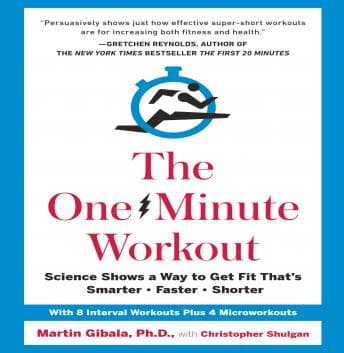

I'm going to be honest with you: I started this audiobook fully prepared to be annoyed.
See, I've spent years studying how people rationalize their behavior, and the fitness industry is basically a crash course in motivated reasoning. "Just one minute!" the title screams, and my psychology-trained brain immediately goes, "Okay, but what's the catch? What cognitive shortcut is this exploiting?" I was ready to dissect this like a case study in false promises.
Then Gibala actually explained his research methodology. And I found myself... taking notes? During my morning jog through Cambridge, no less. The irony was not lost on me.
Why This Book Made Me Argue With Myself
Here's what I didn't expect: Gibala isn't some fitness influencer selling you a dream. He's a researcher who got annoyed that he couldn't find time to exercise, so he literally designed studies to figure out the minimum effective dose. Classic problem-solving behavior rooted in personal frustration - which, psychologically, is exactly the kind of motivation that produces genuine innovation rather than grift.
The research actually shows something counterintuitive: intensity trumps duration in ways that challenge our deeply held beliefs about what "counts" as exercise. Gibala walks through his studies with the kind of methodological transparency that made my academic heart sing. He explains control groups. He discusses limitations. He doesn't oversell.
Sean Pratt brings this same measured, no-nonsense quality to Body Keeps the Score, another book where the science is dense but the narration never lets it collapse under its own weight.But here's what makes this character compelling - and yes, I'm treating the author as a character, fight me - Gibala admits when his findings surprised him. When early critics said HIIT was only for elite athletes, he designed studies specifically to test that assumption. And found it wrong. That's intellectual honesty, which is increasingly rare in the self-help genre.
The "Exercise Snacking" Concept (My Therapist Would Have Thoughts)
The book introduces this idea of "exercise snacking" - brief bursts of activity scattered throughout the day - and I found myself asking: why does this concept feel so psychologically satisfying? Because it removes the all-or-nothing thinking that keeps people stuck. You don't have to "find time" for a workout. You just... do twenty seconds of stair climbing really intensely.
My therapist would absolutely have thoughts about this character - meaning me, the listener who's been telling herself for months that she doesn't have time for strength training while somehow finding ninety minutes for a true crime podcast. The book doesn't shame you for this. It just offers an alternative framework.
The eight workout protocols at the end are genuinely useful. Gibala breaks them down by time commitment and intensity level, which - as someone who appreciates systematic categorization - I found deeply satisfying. Though I'll admit the "10-20-30" protocol sounds like something designed specifically to make me hate my existence for thirty seconds at a time.
Sean Pratt Knows How to Pace Science Writing
Let's talk narration. Sean Pratt has this agile, breezy approach that keeps the research sections from feeling like you're listening to a textbook. He's got eight AudioFile Earphones Awards, and you can tell - the man knows how to make a paragraph about mitochondrial adaptation sound almost exciting.
His pacing is particularly smart during the denser scientific explanations. He doesn't rush through the methodology, but he also doesn't linger in a way that makes you zone out. I listened at 1.0x speed, which is rare for me with non-fiction. Usually I'm at 1.25x minimum. But Pratt's natural rhythm already felt efficient.
The one thing I wished for: more vocal variation during the workout description sections. They're practical and clear, but they blur together a bit. Not a dealbreaker, just a note.
Who Should Listen (And Who Should Skip)
If you're someone who's been paralyzed by the idea that exercise "doesn't count" unless it's an hour at the gym, this book will rewire that thinking. If you're a fellow research nerd who wants to understand the actual science behind HIIT rather than just accepting "it works," you'll appreciate Gibala's transparency.
Skip it if you want a hype-filled motivational experience. This is not that. Gibala is calm, methodical, and occasionally dry. He's not going to yell at you about crushing your goals. Also skip if you're looking for detailed nutritional guidance - this is purely about the exercise side.
The Prescription, If You'll Take It
I finished this book genuinely convinced to try the protocols. Not because Gibala sold me on a dream, but because he showed me the data and let me draw my own conclusions. That's rare. That's valuable.
Psychologically, this doesn't track as typical self-help. It tracks as what self-help should be: here's the evidence, here are the applications, here's how to implement it in your actual life. No false promises. No magical thinking.
My only complaint? The title is technically misleading - the "one minute" refers to the hard exercise portion, but the full protocols are longer with warmups and recovery. Gibala addresses this directly, which I appreciated, but still. Marketing gonna market.
That gap between what the packaging promises and what the evidence actually supports is something I kept thinking about while reading Love Your Body — a book that, unlike Gibala, leans hard into the dream-selling and never quite earns it.Now if you'll excuse me, I have twenty seconds of burpees to suffer through before my next chapter revision.