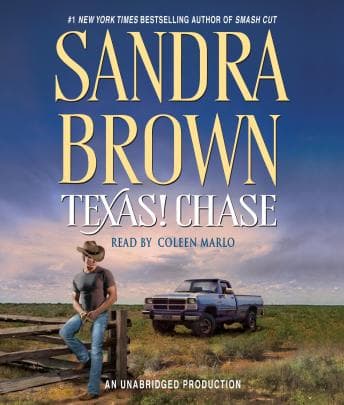

Okay, so here's how this one started: Sophie actually napped — like, a real nap, not the fake-out where she's quiet for eleven minutes and then screams — and I had a full hour and fifteen minutes to myself. I made coffee. I sat in an actual chair. I put my earbuds in and hit play on Texas! Chase, and I did not move until I heard her on the monitor.
High praise. Genuinely.
I came into this one having already listened to Texas! Lucky (the first in the trilogy), so I knew the Tyler family, knew the Texas setting, knew what Sandra Brown was going for. Chase is Lucky's brother, and where Lucky was a little rough-around-the-edges charming, Chase is... grief-hollowed. Like, properly broken. He lost his wife under circumstances that are tangled up with Marcie — the woman who has loved him since grade school — and the guilt and loss and anger between these two is the whole engine of the book.
And honestly? That setup worked on me completely.
The Slow Burn That Actually Burns
What I didn't expect was how much the grief angle would hit. This isn't a breezy enemies-to-lovers situation. Chase is genuinely a mess — not in a fun, brooding way at first, but in a way that made me think, okay, Marcie, sweetie, you have your work cut out for you. The tension between them isn't just romantic, it's loaded with guilt and history and this sense that Marcie has been waiting her whole life for a man who maybe doesn't deserve her yet.
But that's the arc. And Brown earns it. By the time Chase starts to crack open — slowly, reluctantly, like a man who's forgotten how — I was fully invested. The pacing is tight for a romance with this much emotional weight. Seven and a half hours felt right. Not rushed, not padded. I finished it across two nap times and one car-in-the-garage session, and it never lost me on the re-entry. Survived the pause-and-resume test with flying colors.
The plot mechanics — Marcie's plan to save his business, the family tragedy unraveling — these aren't subtle. This is Sandra Brown doing what Sandra Brown does: propulsive, emotionally direct storytelling that doesn't pretend to be literary fiction. Not groundbreaking, but sometimes you don't need groundbreaking. Sometimes you need a man on a ranch learning to feel things again while a woman loves him stubbornly into the light. That's the deal, and it delivers. Anne Morrow Lindbergh was doing something quieter but similarly stubborn about love and solitude in Gift from the Sea — I listened to it during a particularly rough week and it hit in ways I didn't expect from something that old.
The Narrator Situation (Complicated)
Coleen Marlo has a genuinely sultry narrative voice — like, her storytelling register is warm and confident and pulls you right in. When she's in the prose, the pacing feels smooth and the mood lands. So that part? Car time approved.
But the Southern accents in dialogue are... a choice. If you listened to Texas! Lucky first, you already know this going in, and I'll just say: they haven't improved. There's something a little stiff in how she handles Chase specifically — a kind of edge in his voice that reads more hostile than the character actually is on the page. Lucky had the same issue in the first book. It's not a dealbreaker, but it does create this slight disconnect where the narration is warm and the dialogue sounds like someone who's mildly irritated at you.
I adjusted. By hour three I'd basically recalibrated my brain to accept Marlo-Chase as a separate entity from Page-Chase. But if you're someone who needs the character voices to match your mental image exactly, just know going in that there's a gap there.
Borrow It, But Don't Skip It
This is a solid mid-trilogy comfort read. The emotional payoff is real — I did get a little teary during the final stretch (nap time, not school pickup, so we're safe) — and the story is contained enough that you don't need to track seventeen subplots. If you've read or listened to Texas! Lucky, you basically have to continue. The Tyler family has a pull.
Just stream it rather than spending a credit. The narration is good enough to enjoy but uneven enough that I wouldn't call it a must-own. Marlo's prose voice carries the story; the character voices are where your mileage may vary.
My book club would love this. If I ever have time for book club again.