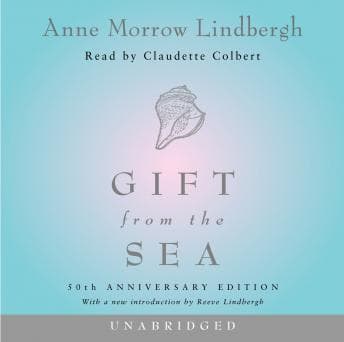

Everyone kept telling me this was the book for women who need to slow down. The self-care classic. The beach read that's actually profound. And I'll be honest—I went in skeptical. I've worked trauma for fifteen years. I've heard every wellness pitch from well-meaning coworkers who think a lavender candle will fix what three back-to-back codes did to my nervous system.
But here's the thing. Anne Morrow Lindbergh wasn't selling anything. She was just a woman sitting on a beach in the 1950s, picking up shells and thinking about her life. And somehow, seventy years later, her thoughts still hit.
The Shell Metaphor That Actually Works
I listened to this during a rare stretch of days off—not in my car for once, but sitting on my back patio at 6 AM while the kids were still asleep and Carlos was snoring through the baby monitor. Two and a half hours. That's it. Shorter than most of my shifts.
Lindbergh uses different shells she finds on the beach as jumping-off points for essays about solitude, relationships, the stages of a woman's life. It sounds precious. It could be precious. But she writes with this unflinching honesty about how marriage changes, how motherhood fragments you, how women are taught to give and give until there's nothing left. She wrote this in 1955 and I'm sitting here in 2024 nodding like she's reading my therapy notes.
The essay about the oyster shell—about how relationships calcify, how couples stop growing together and start just... existing—I had to pause and stare at my coffee for a minute. Carlos and I have been married eleven years. We're fine. We're good. But she names something I didn't have words for.
Claudette Colbert's Voice From Another Era
Here's where it gets interesting. Claudette Colbert—yes, the old Hollywood actress—narrated this, and you can tell it's from a different time. The pacing is slower. The enunciation is deliberate, almost theatrical. Some listeners call it dated.
I didn't mind it. Actually, it kind of worked? The slightly formal delivery matches the meditative quality of the essays. Colbert reads like she's savoring each sentence, which is exactly how this book should be consumed. You're not supposed to rush through it. You're supposed to sit with it.
Reeve Lindbergh—Anne's daughter—provides some additional context, which adds a layer of intimacy. This isn't just a classic being read; it's a family legacy being passed down.
But I'll be straight with you: if you need high-energy narration to stay awake, this isn't it. This is not a 1.5x speed situation. This is a sit-down-and-be-still situation.
What This Book Is (And Isn't)
This is not a self-help book with action items. There are no bullet points. No "5 Steps to Finding Your Inner Peace." Lindbergh doesn't tell you what to do. She just... reflects. And somehow that's more useful than a hundred productivity podcasts.
Some reviewers complained it reads like "something from a traditional woman's magazine." I get that critique. Lindbergh was writing from a particular context—white, privileged, mid-century American womanhood. Her problems are not universal problems. She had the luxury of a beach vacation to have these thoughts.
But the core of what she's saying—that women need solitude, that we lose ourselves in caretaking, that simplicity is not the same as emptiness—that transcends her specific circumstances. My lola in the Philippines never read Anne Morrow Lindbergh, but she would have recognized every word.
Who Needs This (And Who Should Skip It)
This is for you if: you're exhausted in a bone-deep way that sleep doesn't fix. If you've forgotten what you used to think about before your brain became a running to-do list. If you need permission to be still.
Skip it if: you want plot. You want action. You want someone to tell you exactly what to do. Or if slow, deliberate narration makes you want to throw your phone out the window.
At two and a half hours, it's barely a commitment. You could listen to it in a single long bath. (I don't take baths. I take four-minute showers while mentally reviewing patient charts. But theoretically.)
Charting My Own Vitals
I'm not saying this book fixed anything. I still work nights. I still come home with other people's trauma stuck to my scrubs. But for two and a half hours on my patio, I remembered that I'm allowed to want things for myself. First Fifteen Lives of Harry August gave me that same feeling—a quiet reminder that reflection matters, even when the world keeps spinning. That solitude isn't selfish. That the shell doesn't have to give away everything inside it to be beautiful.
My mom would love this. She'd probably cry. She'd definitely call me afterward and say something like, "Anak, you work too hard," and I'd roll my eyes and also know she's right.
Carlos asked why I was being weird at breakfast. I blamed allergies. But really I was just thinking about oyster shells.