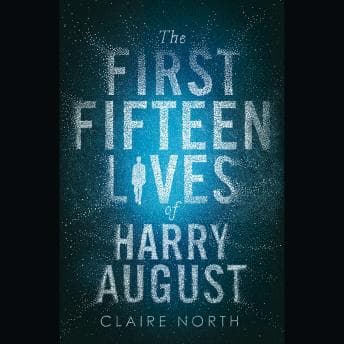

"I nearly missed you, Doctor August."
That line hit me somewhere around hour two, packed into a Caltrain car at 6:47 AM, and I actually looked up from my phone like an idiot. Peter Kenny delivers it with this quiet urgency that just—yeah. That's when I knew this book was going to wreck my sleep schedule.
Bottom Line: Worth your commute. This is basically Groundhog Day meets Cold War espionage, but way more existentially devastating.
The Premise That Broke My Brain (In a Good Way)
So here's the deal: Harry August dies. Then he's born again. Same life, same starting point, but with all his memories intact. He's what they call a "kalachakra"—one of a secret society of people who live their lives over and over, passing messages backward and forward through time by finding each other as children.
The hook sounds gimmicky, right? It's not. Claire North uses this mechanic to ask genuinely uncomfortable questions about what you'd do with infinite time. Would you become a better person? A monster? Would you even care anymore? Harry tries being a physicist, a spy, a recluse, a hedonist. He learns languages, masters skills, watches the same people die over and over. And somewhere around life eleven, a dying child appears at his bedside with a message: the world is ending faster than it should. Someone is accelerating the apocalypse.
I finished this in about four commutes, which for a 12-hour book means I was definitely listening during lunch and probably while pretending to read Slack messages. Fall of Marigolds had that same pull where I'd look up and realize I'd been listening through three meetings. The pacing is—okay, I'll be honest—slow in places. The first few hours are Harry establishing who he is across multiple lives, and if you're looking for immediate action, you'll be frustrated. But the slow burn pays off. The ROI on patience here is massive.
Peter Kenny Is Not Ray Porter, But He's Earned My Respect
Look, I have a narrator problem. Ray Porter has ruined me for other voices. But Peter Kenny? He gets it. His Harry is weary in exactly the right way—not performatively sad, just... tired in his bones. Which makes sense for a guy who's lived through World War II eleven times.
Kenny differentiates between timelines mostly through subtle shifts in energy rather than dramatic voice changes, which works for this book. Young Harry sounds slightly more open, more curious. Old Harry sounds like he's already calculated every possible outcome of the conversation you're having. The villain (and yes, there's a villain, and yes, it's someone Harry knows across multiple lives) gets this chilling reasonableness that made me miss my stop once.
Some reviewers mentioned his accents can get distracting when he's doing characters from different regions—I noticed it maybe twice? There's a Russian character whose accent wobbles a bit, but honestly, by that point I was so invested in the plot I barely registered it. Not a dealbreaker.
Where the Science Actually Holds Up
This is the part where my engineer brain gets happy. North clearly thought through the implications of her premise. How do you coordinate with people who are reborn at different times? What happens if someone kills you as a child before you can remember your past lives? What's the ethical framework for a group of immortals who could theoretically manipulate all of human history?
The Cronus Club—the secret society of kalachakra—has rules. They have politics. They have factions who disagree about intervention. It's basically distributed systems theory applied to time travel, and I am here for it. The "message passing" mechanism where dying members whisper to newborn ones is elegant in a way that made me want to whiteboard it.
The Cold War sections are particularly good. Harry's various careers in intelligence feel researched, not just vibes. And the central conflict—about whether to accelerate human technological progress even if it destroys the world faster—feels uncomfortably relevant.
The Gut-Punch Moments
Without spoiling anything: there's a scene around hour eight involving memory and identity that genuinely shook me. I was walking from Caltrain to the office and had to stop and just... stand there for a minute. The horror elements the genre tags mention? They're not jump scares. They're the slow realization of what immortality actually costs.
Kevin asked me why I was quiet at dinner that night. I tried to explain the concept and he looked at me like I'd grown a second head. "So it's sad Groundhog Day?" Sure, babe. Sure.
Who Should Listen (And Who Should Skip)
This one's for you if you love time-loop stories with actual stakes, Cold War intrigue, or books that make you stare at the ceiling questioning existence. If you need fast pacing from page one, look elsewhere. If nonlinear timelines frustrate you, this will drive you insane—Harry jumps between lives constantly, sometimes mid-chapter. And if you're in a dark headspace already, maybe wait; the existential weight is real.
Perfect for: train, long flights, solo road trips. Skip for: gym (too cerebral), falling asleep (you'll miss something important).
Would I Listen Again?
Honestly? Maybe in a few years. There's definitely stuff I missed in the early hours before I was fully locked in. And knowing the ending changes how you hear the beginning—North plants seeds I didn't catch the first time.
But right now I need something lighter. Twelve hours of contemplating the meaninglessness of linear time has left me weirdly motivated to, like, actually appreciate my one finite life or whatever. Which I guess means the book worked?
1.5x speed worked fine for most of it. I dropped to 1.25x during the climax because Kenny's delivery deserved the full effect.