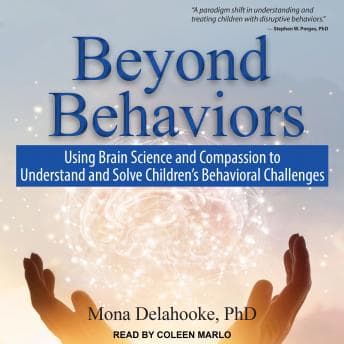

Can we talk about how the entire behavioral intervention field spent decades essentially punishing kids for having nervous systems? Because that's the quiet accusation running through Mona Delahooke's Beyond Behaviors, and honestly — as someone who's spent years studying how narratives shape our understanding of human motivation — I found myself nodding so hard during my Saturday evening dal-making session that I nearly dropped my phone in the pressure cooker.
Here's the thing. Delahooke's central argument is one that should be obvious but apparently isn't: behavior is communication, not defiance. The protagonist here — because yes, I analyze everything like a case study, fight me — is the child whose meltdowns get labeled as Oppositional Defiant Disorder or Conduct Disorder when what's actually happening is a dysregulated autonomic nervous system screaming for help. The research actually shows that bottom-up stress responses (think: fight-or-flight hijacking the prefrontal cortex) look identical to willful defiance from the outside. And we've been treating the outside.
The Iceberg Metaphor That Actually Earns Its Keep
Delahooke uses the iceberg model — behaviors you see above the waterline, everything driving them below — and I'll be honest, when I first heard this framework, I thought: great, another oversimplified visual for a complex problem. But she earns it. She distinguishes between "top-down" behaviors (conscious, intentional choices a child makes) and "bottom-up" behaviors (autonomic stress responses that bypass conscious control entirely), and this distinction is where the book gets genuinely useful. Because the intervention for each is completely different, and misidentifying one as the other is — psychologically speaking — where most parents, teachers, and yes, even clinicians get it catastrophically wrong.
What makes this framework compelling is that Delahooke doesn't just hand you a theory and wish you luck. She walks through Stephen Porges' polyvagal theory in language that doesn't require a neuroscience degree, connects it to real clinical scenarios, and then gives you actual tools. Green, red, and blue "pathways" representing a child's autonomic state. Specific strategies for each pathway. It's the kind of translational work that academic psychology desperately needs more of — taking solid research and making it usable for the people who actually interact with kids every day.
Where My Inner Researcher Got Twitchy
I have to be honest. There are moments where Delahooke makes broad claims about neuroscience that I wanted more citation density on. The book is accessible — really accessible — and that's both its strength and its occasional weakness. Some connections between sensory processing differences and specific behavioral presentations felt slightly oversimplified. My therapist would have thoughts about how quickly we moved from "trauma and toxic stress" to specific intervention strategies without more acknowledgment of individual variation.
But here's where I landed: this book isn't written for me, the researcher who wants seventeen caveats per paragraph. It's written for the parent at 2 AM Googling "why does my child keep hitting" while crying into their coffee. It's written for the teacher with thirty kids and one who keeps flipping desks. And for those audiences? The slight simplification is a feature, not a bug. Delahooke understands human nature — specifically, she understands that people in crisis need clear frameworks, not literature reviews.
Coleen Marlo Does the Heavy Lifting Quietly
Seven hours and fifty-one minutes of what is essentially a clinical psychology textbook disguised as a parenting book. That's a lot to ask of a single narrator. Coleen Marlo handles it with measured, warm clarity that keeps you engaged without ever tipping into that patronizing "and how does that make you FEEL" therapist-voice that plagues so many psychology audiobooks. Her pacing gives you room to absorb dense concepts — I never had to rewind, which for a book this information-heavy is pretty impressive. No sound effects, no music, just clean narration. For this content? Perfect.
I will say: at 1x speed, the delivery felt slightly too measured for my taste. I bumped to 1.15x and found the sweet spot — still clear, but with enough momentum that it stopped feeling like a lecture.
Who Needs This (And Who Might Not)
If you work with kids in any capacity — parent, teacher, therapist, pediatrician — and you've ever caught yourself thinking "this child is just being defiant," this book will reframe everything. I found myself asking: why does the behavioral modification approach persist when we have decades of neuroscience suggesting it's often targeting the wrong mechanism? Delahooke has an answer, and it's uncomfortable. Pinker asks a structurally identical question in Better Angels of Our Nature — why do human institutions keep reaching for frameworks the data has already discredited? — and his answer is equally unsettling, just at civilizational scale rather than one dysregulated child in a classroom.
If you're already deep in polyvagal theory and developmental neuroscience, you'll find the research coverage surface-level. This is an entry point, not a deep dive. And that's okay — not every book needs to be the deep dive.
This Is a Fascinating Case Study in Misreading People
I don't have kids. I study how stories shape identity, not how to manage a meltdown in a grocery store. But Delahooke's framework for understanding children's behavior maps almost perfectly onto how I think about character motivation in fiction. The protagonist exhibits classic stress responses that get misread as intentional action — isn't that basically every misunderstood character arc ever written? We see behavior and assume intention. We skip the iceberg entirely.
Psychologically, this tracks. And it kind of broke my heart a little.