
I was halfway through making my mother's rajma recipe — the one that takes three hours and requires you to watch the pressure cooker like it owes you money — when Roman Ardelean started monologuing about his twin brother's blood disorder, and I nearly let the whole thing boil over. Not because the scene was so riveting I forgot about the dal. But because I found myself asking: why does a cybersecurity genius with unlimited resources and a Vlad the Impaler complex think an unreadable medieval manuscript is going to cure a blood disease?
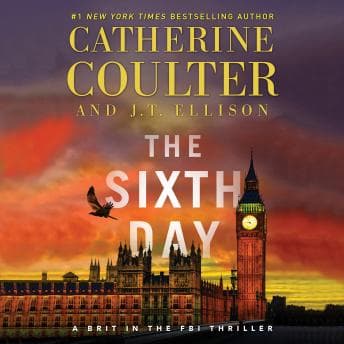
And that question — that gap between brilliant villain setup and slightly bonkers villain logic — pretty much defines my experience with The Sixth Day.
The Ardelean Problem (Or: When Your Villain Is More Interesting Than Your Heroes)
Here's what Coulter and Ellison get right: Roman Ardelean is a genuinely fascinating antagonist concept. A Romanian billionaire descended from Vlad Dracula, obsessed with the Voynich Manuscript — one of the real world's most enduring unsolved puzzles — because he believes it contains a cure for his twin brother's blood disorder. The protagonist exhibits classic savior-complex psychology, twisted through grief and entitlement. That's a villain with an actual emotional engine, not just a cardboard cutout who wants world domination.
But then the book surrounds him with assassination drones, political conspiracies, cryptophasia (twin language — which, as someone who's actually read the research on idioglossia, I was both excited and nervous to see in a thriller), MI5 operations, and a planned attack on London. It's... a lot. The research actually shows that thrillers work best when the central tension is clean and the complications are organic. Here, it feels like two or three different books had a territorial dispute and nobody won. Burning Bright is a good example of a thriller that keeps its central engine lean enough that the complications feel earned rather than piled on.
Nicholas Drummond and Michaela Caine are competent protagonists — he's the Brit-in-FBI with tech skills, she's the gun-toting agent — but they're reactive rather than psychologically interesting. They move from set piece to set piece with the efficiency of people who've done this four times before (because they have — this is book five). I picked this up without reading the previous entries, and while the book is technically accessible as a standalone, there's a flatness to the main characters that suggests their interesting development happened in earlier installments.
Two Narrators, One Uneven Split
MacLeod Andrews and Renee Raudman alternate narration duties, and the quality gap isn't huge but it's noticeable. Raudman brings genuine personality to Michaela Caine — there's a controlled intensity to her read that makes the character feel more dimensional than she might on paper. Her handling of the English female characters shows range, distinct enough that you're not constantly asking "wait, who's talking?" Andrews is a decorated narrator (eight AudioFile Earphones Awards, Audie nominations), and his technical proficiency is obvious. But his sections feel slightly more workmanlike — competent, professional, occasionally missing the emotional gear shift a scene demands.
The dual-narrator approach works for a book that ping-pongs between perspectives, but at 14 hours, there are stretches where the alternation creates rhythm problems rather than solving them. You settle into one narrator's cadence and then get pulled into another. It's not a dealbreaker, but at 1.0x speed, I felt the drag. Bumped it to 1.25x around hour six and the pacing improved dramatically.
Psychologically, Some of This Doesn't Track
My biggest issue — and this is where my professional irritation kicks in — is the Voynich Manuscript subplot. The authors clearly did their homework on it as a historical artifact. But the leap from "unsolved medieval manuscript" to "contains a biomedical cure" requires the kind of magical thinking that the book never properly interrogates. Is Ardelean delusional? Is the manuscript genuinely supernatural in this universe? The book wants it both ways, and that ambiguity isn't the productive kind. It's the "we didn't commit to a lane" kind.
The cryptophasia angle is similarly half-baked. Twin language is a real phenomenon, mostly observed in young children, and it's fascinating — but the book uses it more as a plot device than as something psychologically grounded. My therapist would have thoughts about how this book treats the twin bond: it's presented as almost mystical rather than examining the actual codependency and enmeshment that drives someone to murder for a sibling.
That said — and I want to be fair here — the political assassination sequences are tightly constructed. The drone hovering over the German Vice-Chancellor's death at 10 Downing Street is genuinely eerie, the kind of modern paranoia that makes good thrillers feel urgent. When the book stays in espionage-procedural mode, it works.
Who Gets the Most Out of This
If you're already invested in the Brit in the FBI series, this delivers exactly what you're expecting: fast plot, competent heroes, escalating stakes, London under threat. Series loyalists will eat it up. If you're new — like me — it's entertaining enough but unlikely to convert you. And if you're the type who needs villain psychology to hold up under scrutiny (hello, that's me), you'll spend chunks of this audiobook arguing with the book in your head.
Solid airport thriller. Good on a long drive. Just don't think too hard about why the Dracula descendant thinks a 600-year-old manuscript is better than, say, hiring hematologists. Treasure State scratches a similar itch if you need something to queue up after this — procedural momentum, a protagonist who's reactive by design, decent for the road.
The Case File Closes
This is a fascinating case study in how much a great villain concept can carry a book — and where it starts to buckle under the weight of too many moving parts. Coulter and Ellison understand pacing and plot mechanics. They're less interested in the psychological why, which is where they lose me. The narration is professional if unspectacular, and at 14 hours, you'll want that speed bump. Worth your time on a road trip. Not quite worth rearranging your life for.