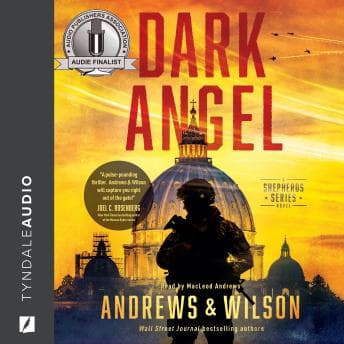
What does it take to make supernatural horror land in a military thriller framework without one genre swallowing the other whole? That's the question I kept turning over while listening to Dark Angel at my library reference desk during a particularly dead Tuesday afternoon shift - earbuds in, the stacks empty, the overhead fluorescents doing their best impression of institutional dread. Fitting, honestly.
Andrews and Wilson are working in territory that should feel crowded - faith-based military thriller with demonic antagonists - but Dark Angel has a specific texture to it that keeps it from collapsing into either Left Behind territory or generic black-ops procedural. Jedidiah Johnson is a former SEAL dropped into the Shepherds organization, and the tension the book actually earns isn't from the supernatural set pieces alone. It's from watching a trained soldier have to reckon with the fact that his entire framework for threat assessment is fundamentally broken. When Jed starts having visions of an overseas attack, the book doesn't treat this as a superpower upgrade. It treats it as destabilizing. That's the right call. Horror - even horror wearing military fatigues - works best when competence isn't enough.
Nicholas Woland as the antagonist is doing something interesting too. The name alone is doing heavy lifting for anyone who's read their Bulgakov (Woland is the devil in The Master and Margarita, and yes, I clocked it immediately, and yes, I appreciated it). He's not just a rogue operator. He's a man who chose a side, and the book lets that choice have genuine theological weight rather than treating evil as a plot mechanism.
Where Macleod Andrews Earns His Keep
The narrator commits. That's rare. Macleod Andrews has this gravelly baseline that works perfectly for military-register characters - there's a clipped efficiency to how he voices Jed and the Shepherds team that reads as authentic without tipping into parody. But where he actually surprised me was in the Woland scenes. There's a particular sequence involving demonic beings and the kind of bloodcurdling horror imagery that lesser narrators would either underplay (too scared to commit) or overplay (scenery-chewing). Andrews finds a third option: controlled menace. Cold. Patient. The horror in those scenes lands because he doesn't rush it.
The supernatural warfare sequences are where the production really earns its 2023 Audies recognition. The tonal shift Andrews manages between a tactical briefing scene and a scene involving actual demonic presence is genuinely impressive - same voice, completely different register. That kind of control is what separates narrators who understand they're performing from narrators who think they're just reading.
I'll be honest that the research I have on this one doesn't surface any major weaknesses in the audio production, and my own listen didn't flag anything either. Clean recording, no distracting artifacts. Sometimes a book just... works technically. That's allowed.
Who This Is Actually For
If you come to this as a pure horror listener expecting Shirley Jackson-level psychological dread, recalibrate. This understands that horror isn't about gore - it's about dread - but it's working within a framework where faith is load-bearing infrastructure, not decoration. The spiritual warfare angle is sincere, not ironic. The Shepherds exist because the authors genuinely believe in the cosmology they're building. That's actually what makes it work - you can feel the conviction.
If that kind of earnest theological horror makes you roll your eyes, this isn't your book. I ran into a similar sincerity problem with Crossed — a book that also asks you to take its mythology at face value, though with considerably less success. But if you've ever found yourself drawn to stories where the supernatural is treated as genuinely real and genuinely dangerous rather than metaphorical? Dark Angel is doing something worth your eleven hours.
Series listeners will note this is a continuation, and Andrews maintains consistent characterization from previous entries - the kind of continuity that matters when you've already invested in these characters.
My podcast listeners are going to love this. Especially the ones who've been asking me for horror that takes its own mythology seriously. This qualifies. Shirley (my cat) was unimpressed when I described the plot to her. I was, genuinely, not.