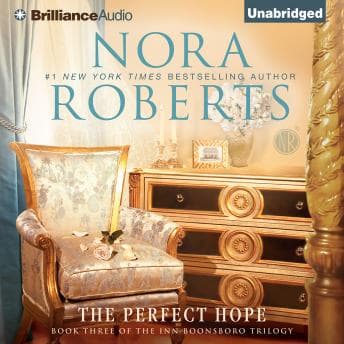

Look, I'll admit something embarrassing. I've been avoiding Nora Roberts for years. Not because I thought her books were bad—I teach high school English, I know better than to be a genre snob—but because with 200-plus novels, where do you even start? The answer, apparently, is the third book in a trilogy. Because that's how I roll.
But here's the thing about Perfect Hope: it didn't matter. Roberts writes with such confident, lived-in warmth that I caught up on the Montgomery brothers and Inn BoonsBoro within the first hour. And honestly? I kind of loved being dropped into a world where everyone already knows each other, where the rhythms of small-town life feel established rather than explained.
The Grumpy Contractor Problem
Ryder Montgomery is the kind of romance hero I usually find insufferable. The strong-silent type. The one who grunts instead of communicates. The guy with "a tough-as-nails outside and possibly nothing too soft underneath." We've all read this character a hundred times.
But Roberts does something clever here. She doesn't try to convince us Ryder is secretly a poet. He's genuinely surly. He's genuinely difficult. And Hope Beaumont—former big-city hotel manager, current innkeeper, perpetually exasperated—calls him on it. Their dynamic isn't "she fixes him" or "he secretly has a heart of gold." It's two competent adults who drive each other absolutely crazy until that tension tips into something else.
The New Year's Eve kiss that kicks everything off? I actually rewound it. (Don't tell my students I said that about a romance novel.)
MacLeod Andrews Understands the Assignment
Here's where my English teacher brain kicks in. A male narrator doing romance is tricky. Get it wrong and Hope sounds like a parody of femininity. Get it wrong the other way and Ryder loses his edge.
Andrews nails it. His Ryder is rough without being cartoonish—there's genuine warmth buried under all that gruffness, and you can hear it creeping in as the story progresses. But what impressed me more was Hope's voice. She's practical, a little guarded, and Andrews captures that without ever making her sound cold. The POV shifts are clean. You always know whose head you're in.
The pacing is excellent too. Roberts writes dialogue-heavy scenes, lots of family banter and romantic sparring, and Andrews keeps the energy up without rushing. I listened at my usual 1.0x because—and I will die on this hill—the rhythm of good prose deserves to be heard as written. But I could see 1.25x working if you're commuting and need to get through it.
When the Past Shows Up Uninvited
The subplot about Hope's "big-city past making an unwelcome appearance" is handled with more nuance than I expected. Without spoiling it, there's a moment where Hope is genuinely vulnerable—embarrassed in a way that feels real and uncomfortable—and Ryder's response is... well, it's not what the grumpy hero playbook would suggest. He doesn't swoop in and fix it. He just shows up. Stands there. Makes it clear he's not going anywhere.
That's the stuff that gets me. Not grand gestures. Presence.
The ghost subplot (yes, there's a ghost at the inn—this is Nora Roberts, after all) adds a nice layer of atmosphere without overwhelming the romance. It's more cozy mystery than horror, which fits the vibe perfectly.
Who Should Listen (And Who Should Skip)
If you love small-town romance with competent adults who have actual jobs and responsibilities, this is your book. If you're a Nora Roberts completist, you probably already own it. If you're like me and have been avoiding her massive backlist, this is actually a decent entry point—the trilogy structure means you get closure, and the world-building is accessible.
Skip it if you need fast-paced action or if enemies-to-lovers dynamics make you roll your eyes. This is a slow burn. The tension builds over months of proximity and bickering. If that's not your thing, you'll be checking the progress bar by hour three.
The Teaching Moment
Here's what I keep thinking about: Roberts has been writing for decades, and you can feel the craft in every scene. The dialogue is efficient. The emotional beats land. There's no wasted space. My students would probably call it "basic" because there's nothing flashy about the prose—but that's exactly what makes it work. This is what accessibility looks like when it's done by someone who's spent decades honing the craft.
That same kind of deceptive simplicity—prose that feels effortless but is actually meticulously crafted—is what made Before We Were Yours work so well for me.
My wife Denise, who has strong opinions about romance novels, stole my earbuds for the last two hours. So. Take that as the endorsement it is.
Andrews' narration elevates already solid material into something genuinely enjoyable. If you're looking for a comfort listen—something warm and satisfying that doesn't require your full attention but rewards it when you give it—Perfect Hope delivers exactly what the title promises.