
"Industrial corn is in almost everything we eat."
I was sitting in my car in the garage—my sacred 45 minutes of silence before going inside to whatever chaos awaited—when that line hit me around hour two. And I just sat there thinking about the Goldfish crackers in my purse. The juice boxes in the fridge. The chicken nuggets my kids would demand for dinner. Corn. All of it. Corn.
Look, I picked this up because Emma is seven and starting to ask questions. Why can't we have McDonald's every day? Why do you buy the expensive eggs? Why is this apple organic and that one isn't? I figured if I listened first, I could translate it for her. What I didn't expect was to have a minor existential crisis in my Honda Odyssey.
When Your Minivan Becomes a Classroom
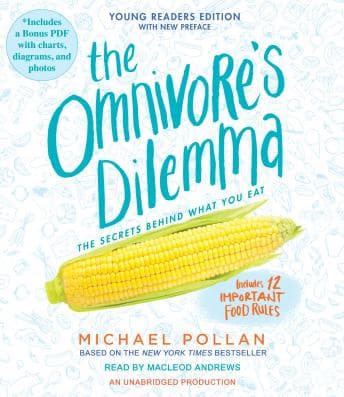
Michael Pollan does something really smart here—he traces four complete meals back to their origins. Fast food, industrial organic, small farm, and foraged/hunted. It's structured enough that I could pause for school pickup, come back, and still follow along. (High praise. Survived 47 pauses and still made sense.) MacLeod Andrews has this boyish, slightly Midwestern quality to his voice that makes the whole thing feel like a really engaging documentary rather than a lecture. He sounds genuinely curious, almost excited, which helps when he's explaining things like how a feedlot works.
The young readers adaptation is smart about what it keeps and what it simplifies. Pollan doesn't talk down to kids—or to me, honestly—but he also doesn't assume you know what monoculture means. The graphs and visuals in the bonus PDF are actually useful if you want to show your kids later, though obviously I couldn't access them while driving.
What surprised me most was how the hunting and gathering section held my attention. I'm a suburban mom whose idea of foraging is finding a parking spot at Costco. But Pollan's descriptions of learning to hunt wild boar and identify mushrooms were genuinely fascinating. Andrews reads those sections with this quiet intensity that made me forget I was in a parking lot.
The Guilt Trip You Didn't Ask For (But Maybe Needed)
Okay, here's the thing. This book will make you feel bad about some of your food choices. There's no way around it. When Pollan breaks down how much petroleum goes into producing a single calorie of processed food, or explains what "free range" actually means legally (spoiler: not much), you're going to side-eye your grocery cart.
But—and this is important for my fellow exhausted parents—he's not preachy about it. The tone is more "here's what I learned, isn't this wild?" than "you're destroying the planet with your Lunchables." At 7 hours and 33 minutes, it's substantial but not overwhelming. I finished it in about a week of car time and nap time listening.
The industrial organic section hit particularly hard. I've been paying extra for organic everything, feeling smug at Whole Foods, and then Pollan gently explains that organic industrial farming isn't really that different from regular industrial farming in terms of environmental impact. The lettuce might not have pesticides, but it still traveled 1,500 miles to get to me. Cool. Cool cool cool.
What I'm Actually Going to Do With This Information
Here's where I landed: I'm not going to become a homesteader. I'm not going to start hunting. I have three kids and approximately zero free time. The whole thing reminded me of the practical relationship advice in Wired for Love—understanding the system doesn't mean overhauling your entire life, just making smarter choices within it. But I am going to start going to the farmers market on Saturdays. Emma can come. We can talk about where food comes from. Maybe Lucas will stop thinking chicken nuggets grow on trees.
The book ends with this really practical message about making better choices where you can, without being perfect. That's exactly what I needed to hear. Not groundbreaking, but sometimes you don't need groundbreaking. You need permission to do a little better without doing everything.
Andrews' narration stays engaging throughout, which is crucial for nonfiction. He doesn't do character voices (there aren't really characters to voice), but his pacing keeps the information digestible. I listened at 1.25x and it worked perfectly.
Who's Going to Love This (And Who Should Keep Scrolling)
This is perfect for multitasking parents who want to feel slightly more informed about what they're feeding their families. It's not a quick fix or a meal plan—it's context. History. The why behind the what. If your kids are starting to ask questions, or if you just want to understand why the grocery store is designed the way it is, this is a solid listen.
Skip it if you're looking for light escapism or if you really don't want to think about high-fructose corn syrup ever again.
Back to the Mac and Cheese
My book club would love this. If I ever have time for book club again.
I went inside after finishing it, made the kids mac and cheese (from a box, with industrial corn derivatives, whatever), and felt... not guilty exactly. Just more aware. Sometimes that's enough.