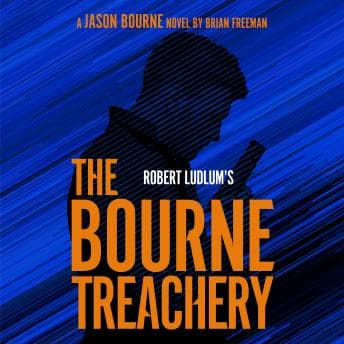

So here's what I expected: another competent Bourne continuation that hits the right beats, keeps the pace tight, and lets me zone out during my evening dal tadka situation. What I got was more complicated than that. And I'm still sorting through whether "complicated" is a compliment here.
I started this one on a Saturday morning jog through Cambridge — earbuds in, November air sharp enough to wake the dead — and by the time the Estonia flashback hit, I'd missed my turn twice. Which is either a sign of an engaging thriller or dangerously poor spatial awareness. Jury's out.
The Ghost of Ludlum and the Problem of Inherited Identity
Let's get the elephant out of the room: Brian Freeman is not Robert Ludlum. He's a good thriller writer occupying someone else's character, and you can feel the seams. The original Bourne novels had this brutal psychological economy — Bourne's amnesia wasn't just a plot device, it was an existential crisis rendered in cold prose. Freeman's version? He understands the mechanics but sometimes mistakes ornamentation for depth. There are passages here that describe settings and characters with a kind of literary flourish that feels wrong for Bourne. The franchise has always been lean. Bourne doesn't linger. He calculates.
That said, the dual-timeline structure — Estonia three years ago, London now — actually works as a psychological framework. I found myself asking: why does Bourne keep circling back to Nova? Freeman treats Nova's death not just as backstory fuel but as genuine grief architecture, and the way Bourne's present-day decisions are contaminated by that loss is, well, psychologically sound. The protagonist exhibits classic complicated grief responses — the hypervigilance, the inability to trust new information about people he thought he knew. When the "everything you knew was a lie" revelation drops, it lands because Freeman has done the emotional groundwork. Mostly.
The "mostly" is where things get shaky. Lennon as an antagonist is a fascinating concept — a shadow assassin named after a peace icon, the irony practically writes itself — but his character motivations get muddy in the back half. There's a point around hour eight or nine where the plot complications start stacking like a Jenga tower that nobody asked to be that tall. Some of the twists felt far-fetched even for a franchise where one man has survived approximately four hundred assassination attempts.
Scott Brick Does the Thing (But Does the Thing Need Updating?)
Scott Brick narrating Bourne is like finding your favorite mug in the cabinet. Reliable. Familiar. You know exactly what you're getting. His voice is clean, measured, authoritative — the kind of narrator who makes you feel like the story is being delivered by someone who takes it seriously. And for a 12-and-a-half-hour listen, clarity matters. I never had to rewind because I couldn't parse a sentence.
But here's where it gets interesting from a listener psychology standpoint. There's a split in how people experience Brick in this particular book. Some hear his steady, professional delivery and feel grounded. Others — and I noticed this too — feel like he's occasionally narrating on autopilot, missing the emotional temperature of certain scenes. During the Nova flashbacks, which should hit with raw grief energy, Brick's delivery stays a notch too controlled. It's like watching someone describe a car accident in the tone of a weather report. Technically correct. Emotionally flat.
He's still good. Let me be clear about that. But "good" and "perfectly calibrated for this specific story" aren't the same thing. The research actually shows that narrator-story fit matters more than raw narrator talent, and I think this is a case where Brick's established Bourne voice doesn't quite stretch to accommodate Freeman's slightly different emotional register.
The Psychology That Works (and the Motivation That Doesn't Track)
What makes this book compelling — when it works — is the identity question. Bourne discovering that his memories of the Estonia mission are wrong isn't just a spy plot twist. It's a case study in how trauma reshapes memory. We reconstruct the past to make it bearable, and when the real version surfaces, it threatens the entire self we've built on the lie. A Head Full of Ghosts does something similarly unsettling with this idea — the question of whether a mind is unraveling or constructing a new identity to survive is the whole engine of that book, and it haunted me for days after. Freeman gets this. The moments where Bourne has to recalibrate his understanding of Nova, of his own choices, of what he's capable of — those are the best scenes in the book.
Psychologically, what doesn't track is the behavior of several supporting characters whose loyalties flip based on plot necessity rather than internal logic. There's a betrayal late in the book that I just... didn't buy. My therapist would have thoughts about this character's supposed motivation, and none of them would be generous. You can't spend ten hours establishing someone's values and then pivot them 180 degrees because the plot needs a third-act shock. The human mind has patterns. Break them, sure — but show me why.
Who This Is Really For
If you're deep in the Bourne audiobook series and you want more of the formula with some genuinely interesting psychological wrinkles, this delivers. If you're a Ludlum purist who considers the continuation novels heresy — honestly, you already know you're going to listen anyway, and you're going to be annoyed, and that's part of the experience for you at this point. If you've never read a Bourne book, don't start here. Go back to The Bourne Identity. Trust me.
My Case File Is Closed on This One
A solid B-minus thriller with an A-minus premise. Freeman understands that Bourne stories are really about a man trying to outrun his own psychology — he just occasionally gets distracted by spy machinery when the emotional engine is right there, humming. I finished it while plating chicken biryani at 10 PM on a Tuesday, alone in my apartment, thinking about how we all construct narratives about our past that may or may not be true.
(My therapist would say that's projection. She's probably right.)