
Look, I needed a palate cleanser.
I'd just finished grading a stack of thirty-two essays on The Great Gatsby, and if I had to read one more teenager explain that the green light represents "money and stuff," I was going to walk into Lake Michigan. My brain felt like mush. I needed something sharp. Something rigorous.
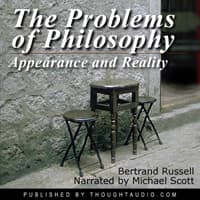
So I saw this: Problems of Philosophy. Bertrand Russell. Twenty minutes.
(Yes, twenty minutes. It's an excerpt. I usually don't bother with these snippet audiobooks—it feels like buying a single slice of bread instead of the loaf—but I had exactly twenty minutes of dishes to wash before Denise got home, so the stars aligned.)
Here's the thing about teaching high schoolers: you spend a lot of time convincing them that things matter. Russell doesn't need convincing. He starts right in on the table. You know the bit—is the table real? What color is it? Well, it looks brown, but if the light hits it there, it's white. So is the table brown or white? Does the table even exist if I close my eyes?
(My students would tell me, "Mr. Williams, please, it is just a table, go touch grass." But this is why I love Russell.)
The Voice in the Void
The narrator is Michael Scott.
No, not that one.
(I admit, I chuckled when I saw the name. I briefly imagined the Regional Manager of Dunder Mifflin explaining epistemology, which frankly might have been an improvement.)
Philosophy is incredibly hard to narrate. If you act it out too much, you sound like a pretender trying to be profound. If you pull back too far, you sound like a GPS.
Michael Scott falls pretty squarely into the "GPS" category.
He is precise. He is clear. His enunciation is the kind of crisp that English teachers dream of. But man, is it dry. Scott brings that same measured precision to Heart of Darkness, which works better for Conrad's atmospheric prose than it does for Russell's logical arguments. We're talking saltine-cracker dry. There's very little modulation in his tone. He treats Russell's beautiful, logical sentences like a list of ingredients rather than a journey of thought.
Does it ruin the book? No. Because Russell is clear enough that the text does the heavy lifting. But there were moments while I was scrubbing a pot where I zoned out for ten seconds because the rhythm of the voice just... flatlined.
Is It Worth The Credit?
It's twenty minutes.
Honestly, I'm torn on the format. On one hand, it's the perfect length for a "commuter college" session. You get in, you question the nature of reality, you get out. It's focused on "Appearance and Reality" (basically Chapter 1 of the full book), which is arguably the best entry point for anyone scared of philosophy.
But on the other hand... just read the book?
Russell won the Nobel Prize for Literature (1950, look it up) because he writes clearly. He isn't Kant. He doesn't obscure his meaning behind three pages of jargon. His prose deserves to be savored, paused over, and underlined. With the audiobook, especially with a narrator who doesn't pause much, you miss the chance to sit with the ideas. I had the opposite problem with Blue Cross—also narrated by Scott—where the pacing felt slightly better suited to the material.
When Russell makes a point about sense-data, I want to stop and look at my own kitchen table. The audio just keeps rolling.
The Verdict
Listen if: You're a philosophy student cramming for an Intro to Epistemology exam and you're tired of reading. It's clean, accurate, and unpretentious. Skip if: You want to actually wrestle with the ideas—grab the print version instead.
If you're like me—an old English teacher looking for a spark—it's a mixed bag. The ideas are electric; the delivery is a bit static.
I listened to it at 1.0x speed, mostly because speeding up a monotone voice just makes it sound like a monotone chipmunk, and nobody needs that while contemplating existence.
It's fine. It's solid. It didn't change my life, but it made washing the dishes slightly more existential. And sometimes, that's all you can ask for on a Tuesday night.