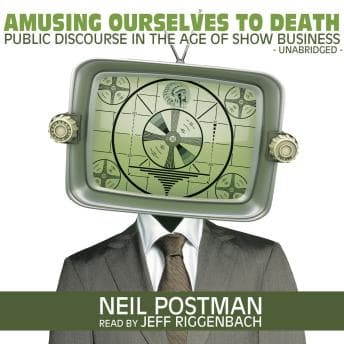

Orwell warned us we'd be overcome by an externally imposed oppression. But Huxley? He figured we'd be destroyed by the things we love. Spoiler alert: Huxley won.
I was prepping a Roghan Josh on Sunday—a process that takes hours if you do it right, which I do—while listening to Neil Postman dismantle the entire foundation of modern discourse. My kitchen smelled like caramelized onions and existential dread. Perfect Sunday, really.
Here's the terrifying thing about this book: It was published in 1985. Postman is screaming about television turning our brains into mush. He's worried about the transition from a "typographic culture" (reading/logic) to a "photographic culture" (seeing/feeling). If he could see TikTok or Twitter today, the man would probably have a stroke on the spot.
As a researcher, I study patterns. And the pattern Postman identifies is undeniable. He talks about the Lincoln-Douglas debates—seven hours of complex argumentation that regular farmers sat through and understood. Today? We have soundbites. Visual stimulation. Context-free information that Postman calls the "Peek-a-Boo World." One minute it's a tragedy in the Middle East, the next it's a commercial for hemorrhoid cream. The brain can't process the emotional whiplash, so it just stops caring. It becomes entertainment.
Jeff Riggenbach: The Professor Who Refuses PowerPoint
The casting here is spot on. Riggenbach doesn't do voices. He doesn't try to "act." He sounds like that one tenured professor who believes in the power of words alone. His delivery is dry, crisp, and slightly stern—which works because the text itself is so fiery. If he tried to emote, it would cheapen the argument. He steps back and lets Postman's logic hit you in the face.
There's no music. No sound effects. Just four and a half hours of realizing why my students struggle to read anything longer than a blog post. It's not their fault; their brains have been rewired by a medium that demands simplicity.
My Mother, the Perfect Case Study
My mother loves Indian news channels. They are loud, colorful, and hysterical—literally flashing graphics and shouting matches. I used to tell her, "Maa, this isn't news, it's a soap opera." She'd wave me off. Listening to this, I realized she's the perfect case study for Postman's theory. The content doesn't matter; the performance does. Truth is irrelevant if it isn't amusing.
Is it dry in places? Sure. It's academic sociology. But it's short. Riggenbach keeps the pace moving—roughly 1.2x speed feels right if you want to match the urgency of the message.
Who This Is For (And Who Should Run)
If you teach, study media, or just want vocabulary for why everything feels broken, this is essential. Skip it if you need optimism or solutions—Postman diagnoses the disease but doesn't prescribe the cure.
The Diagnosis We Didn't Ask For
My therapist says I need to stop consuming media that confirms my cynicism. She's probably right. Though if I'm being honest, Dare to Lead gave me a framework for having those tough conversations about media literacy without sounding like a complete doomsayer. But this book explains why we are the way we are. It's the diagnostic manual for our collective attention deficit disorder. Read it (or listen to it) before we forget how to read entirely.