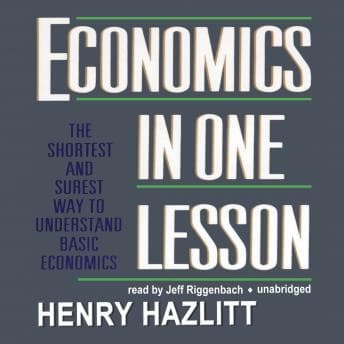

My dad never read a business book in his life. He ran a dry cleaning business in Koreatown for thirty years using common sense, long hours, and an instinctive understanding that when the government "helps," someone's paying for it. I finished Economics in One Lesson on a red-eye from Chicago, and my first thought was: Hazlitt just wrote down everything my father knew in his bones.
This is the rare economics book that respects your time. Under seven hours. No padding. No case studies stretched to fill pages. Hazlitt's thesis is brutally simple: every economic policy has seen and unseen effects, and most bad policy comes from ignoring the unseen. That's it. That's the one lesson. And he spends the rest of the book applying it to tariffs, minimum wage, rent control, public works - basically every economic debate we're still having seventy years later.
What My Parents Did Instinctively, Now With Citations
Hazlitt demolishes the broken window fallacy early, and it hit different at 2 AM somewhere over Nebraska. The idea that destruction creates economic benefit because someone has to fix the damage - I've watched consultants pitch versions of this garbage to Fortune 500 companies. "Disruption creates opportunity." Sure. But Hazlitt forces you to ask: opportunity for whom? At whose expense? What would that money have done otherwise?
The chapter on minimum wage laws made me think of my parents' shop. They hired high school kids, trained them, gave them a first job. When minimum wage jumped, they stopped hiring kids. Couldn't afford the risk. Hazlitt predicted this in 1946. The seen effect: workers who keep their jobs get more money. The unseen: workers who never get hired at all. Gambler: Secrets from a Life at Risk operates on the same principle—every bet has a visible upside and an invisible cost most people refuse to calculate. My parents didn't need an economist to tell them this. They lived it.
Riggenbach Makes Dry Palatable
Jeff Riggenbach's narration is - and I don't say this lightly - actually good for an economics book. His voice has this measured confidence that makes you feel like you're getting a private lecture from someone who genuinely believes what he's saying. No dramatic flourishes. No attempts to make supply curves exciting. Just clear, steady delivery that lets Hazlitt's logic do the work.
I bumped it to 1.5x (my usual 2.0x felt disrespectful to the density here) and found myself actually pausing to think. That doesn't happen often. When Hazlitt walks through how price controls create shortages, Riggenbach's pacing gives you just enough space to connect the dots yourself before moving on. It's teaching, not lecturing.
The Libertarian Elephant in the Room
Look, I'm a consultant. I've worked with government contracts. I've seen waste that would make your eyes water. So Hazlitt's anti-intervention stance lands for me. But I've also seen markets fail spectacularly when left alone. Hazlitt doesn't really grapple with that. His framework assumes rational actors and competitive markets, which - have you met people? 50th Law doesn't make that mistake—it starts with the assumption that people are messy, irrational, and driven by fear.
This is 1946 thinking applied to 2024 problems. Some of it holds up beautifully. The inflation chapter reads like prophecy. Other parts feel incomplete. He dismisses concerns about monopolies in about two paragraphs. Jenny would say I'm being harsh. Jenny is right. But also, I'm not wrong.
The book works best as a corrective. If you've never questioned why "the government should do something" might be the wrong instinct, this is your wake-up call. If you're already a free-market true believer, you won't find much challenge here.
Who Should Listen (And Who Should Skip)
Anyone who slept through Econ 101 and regrets it - this fills that gap in under seven hours. Startup founders who need to understand how policy affects their business without getting an MBA. People who want to argue about economics at dinner parties with actual logic instead of vibes. Skip it if you want nuanced policy debate or if libertarian economics makes your eye twitch.
I've recommended this to three clients this month. Two thanked me. One unfollowed me on LinkedIn. That ratio feels about right.
Bottom Line
Hazlitt delivers 6.5 hours of actual insight with zero filler. The framework is simple enough to remember and apply immediately. Riggenbach's narration is professional without being sterile. It's not a complete economic education - no single book is - but it's the highest ROI economics audiobook I've encountered.
My dad would've never listened to this. He was too busy working. But everything in here? He already knew.