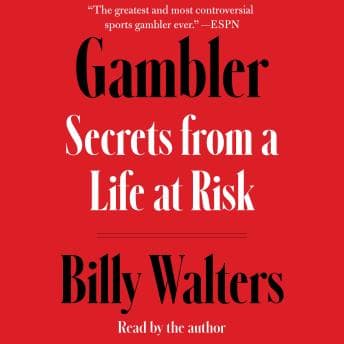

"The house always wins" is the oldest cliché in gambling. Billy Walters spent thirty-six years proving it wrong.
I came to this audiobook as a skeptic. Look, I've spent two decades teaching students that the American Dream narrative is often more mythology than reality. And here's a guy claiming he beat Vegas at its own game for nearly four decades straight. My cynicism was primed and ready.
But here's the thing - Walters doesn't sound like someone selling you a dream. He sounds like your grandfather telling you about the time he got in trouble with the law, except your grandfather also happens to be worth hundreds of millions of dollars and once bet $3.5 million on a single Super Bowl.
The Voice You Didn't Know You Needed
Walters narrates this himself, and I need to be honest with you - it's not polished. His Kentucky drawl sometimes swallows words whole. There were moments during my evening walks along the lakefront where I had to rewind because he'd mumbled through something important about point spreads. Denise asked me twice why I kept stopping and frowning at my phone.
But that roughness? It works. This isn't a performance. It's a confession. When Walters talks about growing up in poverty so severe that hustling pool at nine years old was survival, not recreation - you believe him because he sounds like he's still that kid from rural Kentucky. No amount of money changed his voice, and somehow that makes the whole story more credible.
(Don't tell my students I said this, but sometimes authenticity matters more than technical execution. They'd use that against me forever.)
Where the Numbers Meet the Narrative
The book splits roughly into two halves that don't always sit comfortably together. The autobiography sections read like a novel - organized crime figures, the kind of characters Scorsese would cast Joe Pesci to play, addiction battles, the Phil Mickelson drama that's been tabloid fodder for years. It's genuinely gripping stuff.
Then there are the chapters where Walters breaks down his betting system. Variable analysis. Home field advantage calculations. Weather adjustments. Turf type considerations. This is where Pat McAfee's claim that it's "the sports gambling bible" actually holds up.
I'm not a sports gambler. I put five dollars on the Bears maybe twice a year, mostly as an excuse to care about games I'd otherwise ignore. But listening to Walters explain how he thinks about information - how he mines variables, how he manages money, how he calculates risk - I kept thinking about how this applies to everything. Decision-making. Teaching. Life.
The man treats betting like a profession, not a hobby. There's something almost Hemingway-esque about his approach - the discipline, the craft, the refusal to romanticize what is essentially cold mathematics dressed in the language of sports.
The Uncomfortable Parts
Walters doesn't shy away from his failures. The addictions. The legal troubles that landed him in federal prison. The relationships damaged by obsession. He's not asking for sympathy, exactly, but he's not pretending to be a saint either. That kind of unflinching self-examination reminded me of Adult Children of Emotionally Immature Parents - different subject matter entirely, but the same willingness to look at uncomfortable truths without flinching.
This is where the audiobook format really earns its keep. When he talks about his mistakes, you can hear something shift in his voice. It's subtle - a slight hesitation, a drop in that growling confidence. A professional narrator might have smoothed those moments out. Walters leaves them raw.
If you're sensitive to discussions of gambling addiction, legal troubles, or the kind of moral gray areas that come with making millions from an industry designed to take money from people who can't afford to lose it - this might not be for you. Walters addresses these tensions, but he doesn't resolve them. He's not apologizing for his life.
Who Should Listen (And Who Should Skip)
Sports gambling enthusiasts will find this essential. The formula breakdowns alone are worth the eleven hours. But I'd argue this is also valuable for anyone interested in how obsessive expertise works - how someone becomes the absolute best at something, even if that something is legally and morally complicated.
Skip it if you need polished narration. If mumbling drives you crazy, you'll struggle. And if you have zero interest in sports betting, those technical chapters will feel like sitting through a faculty meeting about budget allocations. (Principal Martinez, still not listening.)
I finished this on a Saturday morning walk, coffee in hand, watching joggers pass by while Billy Walters explained how he calculated the impact of travel distance on NFL point spreads. It felt appropriately American - capitalism, obsession, redemption narratives, and the persistent belief that the system can be beaten if you're just smart enough.
Whether that belief is inspiring or dangerous probably depends on who you are. Walters would probably tell you it's both.









