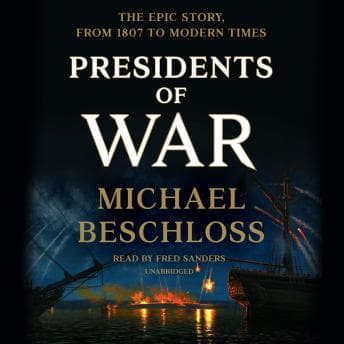
"The power to take the nation into a large-scale conflict has gradually moved from Capitol Hill to the White House" — that's Beschloss laying out his thesis somewhere around hour two, and it hit me like a briefing I'd been waiting 25 years to receive.
I started this one on a long drive back from a client site in San Antonio — corporate vulnerability assessment, nothing glamorous — and I didn't turn it off for the full three hours home. Then I kept going. Twenty-six hours is a serious commitment, but let me cut to the chase: this is the kind of history book that makes you angry and grateful in alternating waves, sometimes within the same chapter.
The Chain of Command Nobody Taught You
Here's what got me. I spent a quarter century following orders that ultimately traced back to the Oval Office. I knew the chain of command. What I didn't fully understand — what Beschloss lays bare with uncomfortable clarity — is how many of those wartime decisions were driven by ego, political calculation, and sheer stubbornness rather than strategic necessity. James Polk essentially manufactured the Mexican-American War by parking troops in disputed territory and waiting for Mexico to shoot first. Lincoln, who I've always admired, suspended habeas corpus and imprisoned newspaper editors. LBJ privately admitted Vietnam was likely unwinnable while publicly escalating because he couldn't stomach being "the first American president to lose a war."
I've seen this scenario play out in real life — the gap between what leadership says at the podium and what they say behind closed doors. Beschloss documents it with primary sources, not speculation. He dug into letters, declassified documents, and conducted interviews with people who were actually in the room. The author clearly did their homework, and ten years of research shows on every page. That same commitment to primary sources and buried history is what made Code Girls stick with me — another book where the real story had been sitting in classified files for decades while the official version went untouched.
What separates this from a standard presidential history is the recurring structural argument: the Founders were terrified of giving one person the power to start wars. They built guardrails. And over two centuries, every single guardrail got bent, ignored, or demolished. By the time you reach the Vietnam chapters, you realize the Constitution's war powers clause has become something between a suggestion and a formality.
Where the Boots Meet the Ground
Beschloss handles the human cost well — not exploitatively, but honestly. The sections on wives and families watching their husbands crack under wartime pressure are genuinely moving. Mary Todd Lincoln's deterioration alongside Abraham's. Lady Bird Johnson listening to her husband agonize over casualty reports. These aren't footnotes in Beschloss's telling; they're central to understanding how war reshapes the people who authorize it.
Now, I'll be straight — this is a book about presidents, not soldiers. If you're looking for tactical analysis or battlefield accounts, that's not the mission here. The focus stays at the executive level: the politics, the arm-twisting, the PR management, the constitutional chess. And honestly? That's fine. Plenty of great books cover the fighting. Not enough cover the deciding.
Fred Sanders narrates with steady, clear delivery. No dramatic flourishes, no character voices — just a disciplined read that matches the gravity of the material. At 1.25x he's perfectly paced. He's not going to make you forget about great narrators like Scott Brick, but he won't get in the way either. For a 26-hour history book, "getting out of the way" is exactly right.
This is where it lost me, if I'm honest — the pre-Civil War chapters can feel a bit heavy on political maneuvering that requires real concentration. Madison and the War of 1812 is dense going. The book picks up serious momentum starting with Lincoln and doesn't really let go through Vietnam. If you bail early, you're missing the best material.
Who Needs This Briefing
Anyone who's served and wants to understand the political machinery that sent them downrange — this is essential reading. Period. Anyone who votes and has opinions about military intervention should probably listen too. It's not partisan; Beschloss takes Democrats and Republicans to task with equal rigor. Polk was a Democrat. McKinley was a Republican. Both come off as manipulative warmongers when the evidence demands it.
Skip it if you want action and combat narratives. This is a policy and leadership book wearing a history book's uniform.
I finished the last chapter around midnight, sitting in my home office with Ranger asleep on my feet. Linda had gone to bed hours ago. I just sat there for a while thinking about the kids I led who never came home, and the chain of decisions — stretching back to the White House — that put them where they were. Not angry, exactly. Just... clear-eyed about it in a way I hadn't been before.
Mission Debrief
Worth your time? Here's the debrief: 26 hours well spent. Beschloss wrote the book I wish they'd handed me at the War College. It won't change your politics, but it might change how you think about the office that holds the launch codes. Ranger approved this one.






![Steve Jobs [unabridged audiobook] audiobook cover](/_next/image?url=https%3A%2F%2Fcovers.audiobooks.com%2Fimages%2Fcovers%2Ffull%2F9788499923406.jpg&w=1920&q=75)