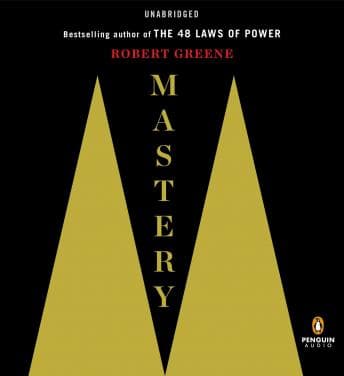

Okay, let's address the elephant in the room first: This audiobook is sixteen hours long.
Sixteen.
I listened to this over the course of about three weeks of morning jogs along the Charles River and—let me tell you—nothing makes you run faster than Robert Greene explaining exactly why you're mediocre. (My therapist says I need to work on my inner critic; Robert Greene says my inner critic needs to be sharper. It's a conflict of interest.)
Here's the thing about Mastery. As a psychologist, I usually roll my eyes at the "Great Man" theory of history. You know, the idea that Einstein, Da Vinci, and Darwin were just magical unicorns born with different brains than the rest of us. It's lazy science.
But Greene does something interesting here. He treats these figures like behavioral case studies. He deconstructs the process—the 10,000 hours, the tedious apprenticeships, the social awkwardness. He argues that genius is a behavior, not a trait. And honestly? The research—while totally anecdotal and lacking hard stats—actually tracks with what we know about neuroplasticity and habit formation.
The Narration Situation
Fred Sanders. The man has a voice like a heavy oak desk.
Seriously. If you're going to listen to a book that basically tells you to stop complaining and start working, you need a narrator who sounds like a stern but benevolent university dean. Sanders is clear, articulate, and weirdly convincing. He doesn't do the over-the-top "motivational speaker" voice (thank god). He just delivers the text with this calm, absolute conviction that makes you think, "Yes, Fred, I should spend five years in a silent apprenticeship. Why didn't I think of that?"
He adds a level of plausibility that might have been lost with a more dramatic performer. Greene's writing can get a little... intense. Machiavellian, almost. (If you want full-on Machiavellian Greene, 48 Laws of Power is where he really leans into that energy.) Sanders grounds it.
The Psychology of It All
My dissertation committee would hate this book. There are no p-values. No control groups. It's all stories. But—and this is the hill I will die on—stories are how we encode information.
Greene understands narrative identity better than most academics. He uses the lives of historical figures to create a blueprint. Is it scientifically rigorous? No. Is it psychologically effective? Absolutely.
I found myself pausing in the middle of chopping onions (making a curry I definitely didn't need to spend 3 hours on) to write down notes about the "Rigorous Apprenticeship" phase. It hits close to home. The idea that you have to submit to the process before you can break the rules? That's just graduate school in a nutshell.
Greene explores similar power dynamics in 50th Law, though that one's more about survival than craft—different context, same underlying psychology of discipline.
Case Closed
Look, this isn't a "feel good" listen. It's not going to tell you you're perfect the way you are. It's the literary equivalent of an Indian mother asking why you only got a 98 on the exam.
But if you're feeling stuck, or if you're obsessed with the why behind human achievement, this is fascinating stuff. Just maybe listen at 1.25x speed unless you want to spend a literal month with Charles Darwin.
Who Should Listen (And Who Should Skip)
This one's for the obsessives—people who want to understand the mechanics of expertise, not just be told they can do it. Skip it if you need validation or if sixteen hours of "here's why you haven't put in the work yet" sounds like torture rather than motivation.