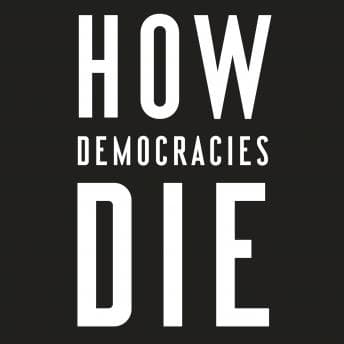

Couldn't sleep last Tuesday. 0200 hours, staring at the ceiling, brain running hot after a client meeting about insider threat protocols. Figured I'd put something on that matched my mood - something serious, something with stakes. Queued up How Democracies Die and let Fred Sanders talk me through eight hours of political science that, frankly, kept me awake longer than the insomnia did.
Let me cut to the chase: this book is a clinical, unflinching autopsy of how democracies collapse - not with tanks rolling through the streets, but with elected leaders quietly dismantling the guardrails from the inside. Worth your time? Here's the debrief.
The Threat Briefing You Didn't Know You Needed
Levitsky and Ziblatt lay out what they call the four key indicators of authoritarian behavior - rejecting democratic rules of the game, denying the legitimacy of opponents, tolerating or encouraging violence, and curtailing civil liberties. They apply this framework like a diagnostic checklist, running it against figures from Fujimori in Peru to Chávez in Venezuela to Orbán in Hungary. It's the kind of structured analytical approach that would've felt right at home in any intelligence briefing I ever sat through. Clear criteria, historical examples, pattern recognition. These guys think like analysts, not pundits.
What really landed for me was their argument about the two unwritten norms that kept American democracy functioning for most of its history: mutual toleration (accepting your opponents as legitimate) and institutional forbearance (not using every legal power available to you just because you can). They trace these norms back to the post-Civil War era, and here's where it gets uncomfortable - they're honest about the fact that bipartisan cooperation in America was partly built on the exclusion of Black Americans from the political system. The stability of the mid-20th century wasn't some golden age of principle. It was a compromise that came at a brutal cost. That chapter hit me harder than I expected. That same willingness to sit with the uglier chapters of American history - the ones that don't resolve neatly - is what made Bury My Heart at Wounded Knee one of the harder listens I've put myself through in recent years.
Where the Perimeter Gets Thin
Now, here's where I have to be straight with you. The book was published in 2018, and it shows. The analysis is rooted in the early Trump era, and while the historical framework holds up, some of the specific political references feel locked in time. That's not necessarily a flaw - it's a snapshot - but if you're picking this up years later, you'll notice it.
The other legitimate criticism I've seen from listeners is that the non-US case studies, while effective, stay at surface level. You get Venezuela and Turkey and Hungary as examples, but they're deployed in service of the American argument rather than explored on their own terms. I've seen this scenario play out in real life - when you're building a briefing for an American audience, you use foreign examples as supporting evidence, not as the main effort. Smart strategy for book sales, maybe, but if you're someone who already knows the comparative politics literature, you'll want more depth than what's here.
The authors clearly did their homework on the American political system's pressure points though. Their analysis of how political parties historically served as gatekeepers against extremist candidates - the "invisible primary" system where party insiders could filter out demagogues before they reached voters - is sharp. And their argument about how the democratization of the primary process in the 1970s inadvertently weakened that gatekeeping function? That's the kind of structural insight that sticks with you long after the listen.
Fred Sanders: The Right Man for the Mission
Sanders narrates this the way it should be narrated - straight, measured, no theatrics. When you're dealing with material about the erosion of democratic institutions, the last thing you want is some narrator cranking up the drama like he's reading a Tom Clancy climax. Sanders keeps it even. His pacing matches the academic tone without putting you to sleep, which is harder than it sounds. (Trust me, I've listened to enough academic audiobooks narrated by people who apparently learned their craft reading bedtime stories to toddlers.) At 1.25x he was perfect - crisp and conversational without losing anything.
No music, no sound effects, no production gimmicks. Just one narrator delivering a clear argument clearly. For this kind of book, that's exactly right.
Who Needs This Intel
If you're someone who wants to understand the mechanics of democratic decline - the actual structural and institutional processes, not just Twitter-level outrage - this belongs in your library. Military folks, security professionals, anyone who thinks about systems and how they fail. It reads like a vulnerability assessment of American governance, and that framework is genuinely useful regardless of where you sit politically.
Skip it if you want a partisan screed confirming your existing opinions. The authors have a clear perspective, no doubt, but the analytical framework itself is nonpartisan. Also skip it if you're looking for solutions - the prescriptive chapters at the end are the weakest part of the book. Diagnosing the disease is always easier than prescribing the cure.
Ranger slept through most of this one, but he's a dog. He doesn't vote. For the rest of us who do, this is required reading. Mission accomplished - with caveats about the expiration date on some of the specific political analysis.







![Steve Jobs [unabridged audiobook] audiobook cover](/_next/image?url=https%3A%2F%2Fcovers.audiobooks.com%2Fimages%2Fcovers%2Ffull%2F9788499923406.jpg&w=1920&q=75)