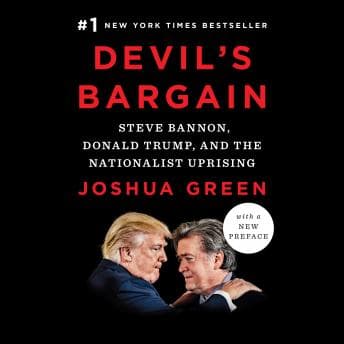

Look, I have a rule about political books: if you can predict every conclusion before chapter 3, the author wasted your time. Green's book breaks that rule—but not in the way you'd expect.
I finished this during a red-eye to Chicago, prepping for a client meeting about organizational culture gone toxic. Seemed appropriate. Eight and a half hours of dissecting how a Hollywood-reject-turned-Breitbart-chairman helped reshape American politics. At 2.0x, it was still dense enough to keep me from sleeping, which is saying something after the week I'd had.
The McKinsey Consultant's Nightmare
Here's what got me: Bannon's strategy wasn't chaos. It was *methodical* chaos. Green traces how Bannon spent years—literally years—building infrastructure for a moment that hadn't arrived yet. The Biosphere 2 disaster. The Clinton Cash documentary. The Seinfeld royalties funding right-wing media experiments. Each piece sounds absurd in isolation. Together? It's a case study in asymmetric warfare that would make any strategy consultant uncomfortable.
I've sat in boardrooms watching executives dismiss scrappy competitors as "not serious threats." I've watched those same executives update their resumes six months later. Bannon understood something the political establishment didn't: you don't have to win the existing game. You change what game is being played.
Green's six years of access pays off here. This isn't punditry dressed up as journalism. The man was in the room. He watched Bannon's Breitbart operation before anyone cared. That longitudinal view—watching someone build something from the fringe to the center of power—is genuinely rare in political reporting.
Fred Sanders Does the Heavy Lifting
Sanders narrates this like a Bloomberg terminal reads data: clean, neutral, no editorializing. Which is exactly right for material this charged. He doesn't try to voice Bannon as some cartoon villain or Trump as a buffoon. The restraint actually makes the content hit harder. When you're describing someone's plan to "burn it all down," you don't need dramatic inflection. The words do the work.
Some listeners apparently found the book "difficult to focus on due to perceived bias." I get it. But here's the thing—Green lets Bannon explain himself, extensively. If you walk away thinking Bannon's been demonized, that's because you heard Bannon's own words and worldview in full context. That's not bias. That's journalism.
What My Parents Would Have Recognized
The populist anger Green describes? My parents lived a version of it. Koreatown, 1992. Watching their neighborhood burn while the cops protected wealthier areas. They never became political radicals, but they understood—viscerally—what it meant to feel abandoned by institutions that claimed to represent you.
Green captures that current running through American politics. The economic anxiety, the cultural displacement, the sense that the rules only apply to certain people. Fresh Off the Boat captures a different version of that immigrant experience—less anger, more hustle, but the same underlying tension with institutions that never quite saw you. He doesn't excuse where Bannon channeled that anger. But he explains it. And explanation isn't endorsement—it's how you actually understand what happened.
The Eight-Hour Question
Is this worth your time? Depends on what you want.
If you're looking for a "Trump bad" or "Trump good" polemic, skip it. Green's more interested in *how* than *whether*. If you want to understand the mechanics of political disruption—the actual blocking and tackling of building a movement from nothing—this delivers.
The key takeaway is worth the listen. The other 7 hours? Actually, also worth it. Green doesn't pad. Each chapter builds on the last. The Seinfeld money-to-Breitbart pipeline alone is worth an hour of your commute.
Jenny would say I'm being too generous to a book about people I clearly find distasteful. Jenny is right. But understanding your adversaries isn't the same as admiring them. My parents taught me that too.
The Bottom Line
This is the best explanation I've encountered of how 2016 happened. Not the polls, not the tweets, not the daily outrage cycle—the actual years-long strategy that made it possible. Green wrote a business case study disguised as political journalism.
**Who should listen:** Anyone in strategy, politics, or organizational change who wants to understand how outsiders capture institutions. **Skip if:** You need your political books to tell you who to root for. Green assumes you're an adult who can handle complexity.
I landed in Chicago having rethought three assumptions about institutional disruption. That's a solid ROI for eight hours of flight time.







![Steve Jobs [unabridged audiobook] audiobook cover](/_next/image?url=https%3A%2F%2Fcovers.audiobooks.com%2Fimages%2Fcovers%2Ffull%2F9788499923406.jpg&w=1920&q=75)