
I usually prefer my conflict resolved with semicolons, not sleeper holds. But here I am, sitting at my dining room table on a Sunday night, staring at a stack of ungraded essays on The Great Gatsby, listening to a man explain the mechanics of strangulation.
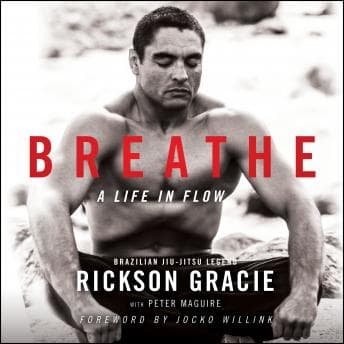
Rickson Gracie isn't just a fighter, though. That's the trick. And Breathe isn't really a sports book. It's a philosophy text disguised as a memoir.
I picked this up because one of my students—a quiet kid in the back row who usually sleeps through my lectures on symbolism—wouldn't stop talking about the Gracies. I wanted to see what the fuss was about. Six hours later, I get it. This is basically Stoicism with consequences. If Marcus Aurelius had to fight for money in 1980s Japan, he'd probably sound a lot like Rickson.
The Voice in the Room
Fred Sanders narrates this, and frankly, it was the right call not to have Rickson read it himself. Sanders has this specific kind of gravel in his voice—the kind that sounds like it's seen some things. He doesn't try to do a Brazilian accent (thank god), and he doesn't hype up the violence. He reads with a steady, metronomic cadence that actually mirrors the book's central thesis: control your breath, control your panic, survive.
There's a section where Rickson talks about the death of his son, Rockson. It's a gut-punch. Sanders slows down just enough. He lets the silence do the heavy lifting. A lesser narrator would have milked that for melodrama. Sanders just states the facts, and the restraint makes it hurt more. It reminds me of the "Iceberg Theory" we talk about in class—the power is in what isn't screamed at you.
Rio, Tokyo, and the Ego
The structure is tight. At roughly six and a half hours, it doesn't overstay its welcome. We get the history of the Gracie family in Rio—which reads like a violent soap opera—and the eventual explosion of the UFC. But the most interesting parts aren't the fights. It's the spaces between them.
Rickson talks about "invisible Jiu-Jitsu"—the connection between mind and body. Listening to this while trying to force myself to grade papers was actually... instructive. The man is talking about maintaining composure while a 250-pound opponent tries to take his head off, and I'm here stressing about a faculty meeting. Puts things in perspective.
If you're looking for a play-by-play of every single match, though, you might be disappointed. This is a "Why I Fight" book, not a "How I Fight" manual (though there is a PDF included, which I glanced at but mostly ignored because I'm not planning on entering the Octagon anytime soon).
Who Should Listen (And Who Should Skip)
If you're drawn to books about discipline, flow states, and the suppression of ego—regardless of whether you've ever set foot on a mat—this one's for you. Skip it if you want a blow-by-blow fight manual or if combat sports are a hard no. My mom would hate this. She'd say it's too violent. But she'd be missing the point.
Cliff Notes
Will to Change circles some of the same territory from a completely different angle—less about physical mastery, more about what men do with all that internal pressure when there's no opponent in front of them.
Sanders delivers a performance that respects the gravity of the subject matter without becoming self-serious. It's efficient. It's clean. He does something similar in Mastery—that book has the same no-nonsense delivery, and the subject matter (the long road to genuine expertise) pairs almost unnervingly well with what Rickson is saying here. And much like the martial art it describes, it doesn't waste any movement.