
How many times have you walked out of a salary negotiation, a vendor meeting, or even a conversation with your landlord thinking "I definitely left money on the table"? Because same. Constantly.
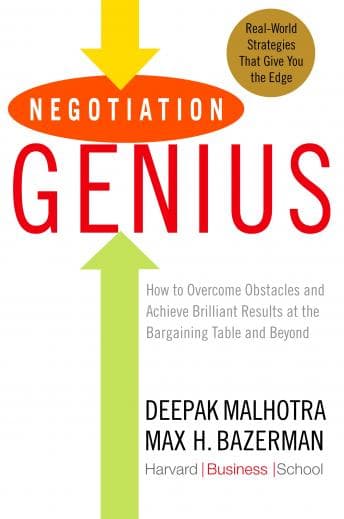
I picked up Negotiation Genius during a particularly brutal sprint at work where I was also trying to renegotiate my lease (spoiler: my landlord won that round). Twelve hours is a commitment for a business book—most of these could be blog posts, let's be real—but this one actually earns its runtime.
The Harvard Framework That Actually Sticks
Deepak Malhotra and Max Bazerman are Harvard Business School professors, which normally makes me brace for academic jargon that sounds impressive but tells you nothing actionable. Not the case here. They break down negotiation into frameworks you can actually use. Like, Monday morning use.
The BATNA stuff (Best Alternative to a Negotiated Agreement) isn't new if you've read any negotiation book ever, but they go deeper. They talk about how to strengthen your BATNA before you even walk into the room, how to estimate the other side's BATNA when they're actively trying to hide it, and—this is the part that got me—how to negotiate from a position of weakness without looking desperate. That chapter alone was worth my 6 commutes.
What I appreciated is they don't pretend everyone negotiates in good faith. There's a whole section on dealing with hardball tactics, lies, and ultimatums. The talking points they give you are specific. Not "try to build rapport" but actual scripts for when someone threatens to walk away or drops a last-minute demand.
Fred Sanders Does the Heavy Lifting
Fred Sanders narrates this, and he's got that Earphones Award-winning clarity that makes dense material digestible at 6AM. His pacing is solid—not so slow you zone out, not so fast you miss the framework you're supposed to be internalizing. For business nonfiction, that's basically the whole job, and he nails it.
Here's the catch though: this book is structured like a textbook. Lots of concepts building on each other, case studies, examples. Some listeners find it tough to navigate in audio format, and I get it. If you're the type who likes to flip back and forth or highlight key points, you might want the physical copy alongside. I listened at 1.25x and rewound a few sections during my morning commute when I was still half-asleep.
The production quality is clean—no weird audio artifacts or background noise. Just Sanders, the content, and your brain trying to absorb negotiation tactics while surrounded by other Caltrain zombies.
Where It Drags (And Where It Doesn't)
Look, 12 hours is long for this genre. The middle section on influence tactics felt a bit repetitive—I got the point after the third case study, guys. But the opening chapters on preparation and the later chapters on ethical negotiation and relationship-building? Those flew by.
The ethical negotiation stuff surprised me. Most negotiation books treat ethics as an afterthought, a "oh and don't be a jerk" footnote. How to Live on Twenty-Four Hours a Day has that same intentionality about making deliberate choices instead of just coasting through. Malhotra and Bazerman spend real time on it. How to create trust, how to build long-term relationships while still getting what you need, when walking away is actually the smart play. This isn't just about winning one deal—it's about not burning bridges you'll need later.
The ROI Calculation
Quick verdict on utility: I used the ZOPA framework (Zone of Possible Agreement) in a vendor negotiation two weeks after finishing this. Saved my team about 15% on a contract renewal. The ROI on this audiobook is legitimately quantifiable for me, which is rare.
Perfect for: commute, gym, any time you can give it like 70% attention. Skip for: bedtime (you'll fall asleep and miss the good parts) or deep work (you won't be doing deep work anyway if you're listening to an audiobook).
Who should skip this entirely? If you want entertainment, this ain't it. If you're looking for a quick tips listicle, go read a blog post. But if you're a business professional who negotiates anything—salary, contracts, project scope, whatever—and you want a systematic approach that actually works when the other side is being difficult? This is your book.
The BATNA Thing Works
I finished this in about 3 weeks of commutes, and I've already recommended it to two coworkers who were about to walk into performance review season unprepared. One of them texted me after her negotiation: "The BATNA thing worked."
That's the review, really.