
What makes a posthumous novel worth listening to? Loyalty to the author? Curiosity about unfinished business? Or just the hope that lightning might strike one more time?
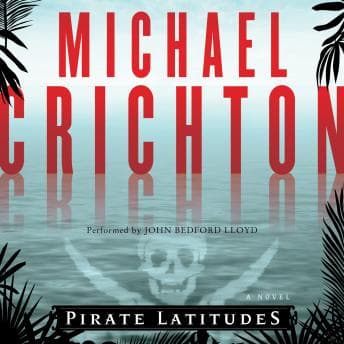
I asked myself this while walking the lakefront last Tuesday, earbuds in, pretending I was grading papers in my head. (I wasn't. I was somewhere in the 17th century Caribbean watching a privateer named Captain Charles Hunter plan an impossible heist.) Michael Crichton died in 2008, and his estate found this manuscript in his files. Dragon Teeth came from the same posthumous vault, and honestly, it had the same unpolished-but-entertaining energy. That's either a gift or a warning, depending on your expectations.
Here's the thing: Pirate Latitudes is not Jurassic Park. It's not even Timeline. It's closer to The Great Train Robbery—Crichton doing a historical heist without the sci-fi scaffolding. But it's also not trying to be. This is Crichton doing something I didn't know he had in him—a straight-up swashbuckler. No dinosaurs. No time travel. No nano-anything. Just pirates, treasure, and enough sword fights to make my 10th graders actually pay attention if I assigned it. (I won't. Content warnings exist for a reason.)
Genre Fiction Isn't Lesser Fiction
Look, I've spent twenty years teaching kids that genre fiction isn't lesser fiction—it's just honest about what it's selling. Crichton always understood this. The man wrote theme park thrillers before theme parks were the theme. And here, stripped of his usual techno-thriller machinery, you can see his bones as a storyteller.
The plot is simple: Jamaica, 1665. Captain Hunter gets hired to steal Spanish gold from a supposedly impregnable fortress. He assembles a crew. They sail. Things go wrong. Things go really wrong. More things go wrong. Someone might be a traitor. There's a kraken. Yes, a kraken.
It's pulpy. It's violent. It's exactly what it promises to be.
And honestly? After a semester of teaching Beloved and watching teenagers struggle with Toni Morrison's fractured timelines, there's something refreshing about a book that just... moves. The pages and minutes fly by—that's not hyperbole. I finished this in three days of commutes and one very long faculty meeting where Principal Martinez was definitely saying important things about the budget.
Lloyd's Swagger (and His Accents)
John Bedford Lloyd narrates, and he gets it. His voice has this cool, straightforward quality that matches Hunter's bravado perfectly. Hunter is arrogant, competent, and ruthless—basically the anti-hero before anti-heroes were a marketing category—and Lloyd plays him with just enough swagger without tipping into parody.
The supporting cast is where things get interesting. Lloyd does accents. Lots of accents. Spanish governors, French sailors, English aristocrats, a Moor, a Jewish explosives expert. Some of these work beautifully. Others... well, let's just say his European accents occasionally sound like a community theater production of The Three Musketeers. (Don't tell my students I said that. They already think I'm a snob.)
But here's what matters: he keeps the story moving. The pacing never drags. When the action kicks in—and it kicks in often—Lloyd matches the energy without overselling it. There's a sea battle sequence that genuinely had me walking faster along the lake, like my pace could somehow affect the outcome.
I listened at 1.0x, as I always do, because the author chose those words. And Crichton's prose here is lean. Almost too lean in places. This isn't a book that rewards savoring individual sentences. It's propulsive, cinematic, and clearly written with a movie adaptation in mind. (Which, knowing Hollywood, will probably happen eventually.)
Where the Seams Show
I'd be lying if I said this was top-tier Crichton. The ending feels rushed—like he ran out of manuscript before he ran out of story. The final chapters lack the tight construction of his best work. Characters who seemed important early on fade into the background. A few plot threads just... stop.
This is a posthumous novel, and it reads like one. You can feel the absence of a final revision, that last pass where Crichton would've tightened the screws. It's like reading a really good first draft from a master craftsman.
Also—and this is minor—some listeners have reported skipping issues in the audio. I didn't experience this, but it's worth mentioning if you're particular about production quality.
Who Gets the Extra Credit (and Who Should Skip)
If you want literary depth or polished prose, look elsewhere. Same if graphic violence and sexual content aren't your thing. But if you're a Crichton completist, a sucker for heist plots, or just need something propulsive for your commute? This delivers.
Absolutely not assigning this to my students. The violence is graphic. The sexual content is... present. Their parents would have opinions.
But would I recommend it to a colleague looking for summer listening? Without hesitation. This is beach reading for your ears. A good adventure, told well, performed with energy. It won't change your life. It won't make you think deep thoughts about the human condition.
Sometimes that's exactly what you need.
Class Dismissed
My students would probably love this, actually. They'd just have to find it themselves.