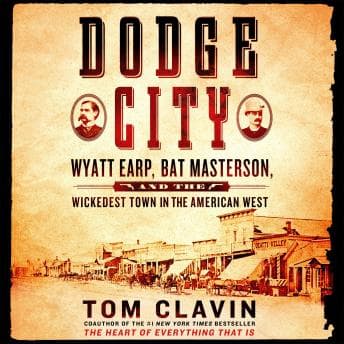
Most people think they know Dodge City. Wyatt Earp walks into a saloon, there's a shootout, somebody falls through a railing, credits roll. I went into this one expecting a decent retread of Hollywood mythology with some historical footnotes, and what I got was something considerably more interesting - and considerably more complicated.
I was up at 0430, couldn't sleep (old habit that won't die), sitting on the back porch with coffee while Ranger dozed at my feet. Perfect time for a 13-hour history book, honestly. The neighborhood was dead quiet, which let me actually focus, and this one demands your focus.
The Real War for the West Was Fought with Paperwork
Let me cut to the chase - Tom Clavin's real achievement here isn't the gunfights. It's showing that Dodge City's transformation was fundamentally a political operation. Earp and Masterson weren't just fast draws; they were political operators working within (and sometimes around) a system that was being built in real time. The cattle trade, railroad money, saloon interests, competing factions of businessmen - Clavin lays out the power dynamics behind frontier law enforcement in a way that felt uncomfortably familiar. I've seen this scenario play out in real life, just in different theaters. You want to stabilize a lawless region? You need buy-in from local power brokers, you need funding, and you need people willing to do the dirty work. The machinery behind that kind of power - who funds it, who benefits, who gets buried - is something Secret Empires maps onto modern American politics with the same unsettling clarity. Dodge City in the 1870s wasn't so different from certain provincial cities I could name.
The author clearly did their homework. Clavin pulls from newspapers, court records, personal correspondence - the kind of primary source work that separates real history from campfire stories. The Dodge City War section, where Earp and Masterson return after Jim Masterson gets squeezed out, reads less like a Western and more like a political thriller. There's an actual telegram exchange coordinating the response that feels like watching a joint operations order come together.
But here's the thing - and this is where it lost me at times - the cast of characters is enormous. Clavin isn't content to just cover Earp and Masterson. He brings in Wild Bill Hickok, Doc Holliday, Buffalo Bill Cody, Jesse James, John Wesley Hardin, Billy the Kid, even Theodore Roosevelt. That's an ambitious roster for any book, and at points it feels like Clavin is trying to write the definitive encyclopedia of the frontier era rather than telling one focused story. I lost track of minor characters more than once. Which Masterson brother are we talking about now? Which faction does this cattle baron belong to? At 1.25x speed, some of those transitions hit fast and I had to rewind.
Lloyd's Baritone Carries the Load
John Bedford Lloyd narrates with this warm, resonant baritone that fits the material like a worn leather holster. There's an endearingly corny western drawl he leans into - not overdone, just enough seasoning to remind you this isn't a textbook. His enunciation is crisp, which matters when you're processing a dozen new names per chapter. For a single narrator handling what's essentially a cast of hundreds, he keeps things moving with genuine confidence.
No complaints on the audio production side. Clean recording, consistent levels, no weird artifacts. At 1.25x it flows naturally - Lloyd's deliberate pacing at normal speed might test your patience through some of the denser political sections, so bumping the speed is my recommendation.
Who This Is Actually For
If you're a casual Western fan looking for shootout-to-shootout action, you might find stretches of this book slow. Clavin spends serious time on context - the economics of the cattle drives, the railroad politics, the shifting alliances between lawmen and business interests. That's the good stuff, in my opinion, but it requires engagement.
If you're a history nerd who wants to understand how the American West was actually won - not the dime novel version - this is worth your time. Miracles and Massacres scratches a similar itch - it goes after the same campfire-story myths about American history and trades them in for something grittier, though I'd say Clavin's sourcing runs deeper. The friendship between Earp and Masterson is the emotional spine of the book, and Clavin earns the moments when their personal loyalty intersects with public duty.
One note: Clavin sometimes gets so deep into setting the historical record straight that the narrative momentum stalls. There are passages that read more like corrective footnotes than storytelling. I respect the impulse, but it occasionally kills the rhythm.
Mission Debrief
Worth your time? Here's the debrief. Dodge City is a serious, well-researched history that strips away the Hollywood varnish and shows you something messier, more political, and ultimately more interesting than the myth. Lloyd's narration is rock solid. The book occasionally buckles under its own ambition - too many characters, too many tangents - but when Clavin locks onto the core story of two friends trying to impose order on chaos, it hits. I've lived that story, just in different dirt.
Ranger slept through most of it, but he perked up during the gunfight descriptions. Make of that what you will.






![Steve Jobs [unabridged audiobook] audiobook cover](/_next/image?url=https%3A%2F%2Fcovers.audiobooks.com%2Fimages%2Fcovers%2Ffull%2F9788499923406.jpg&w=1920&q=75)